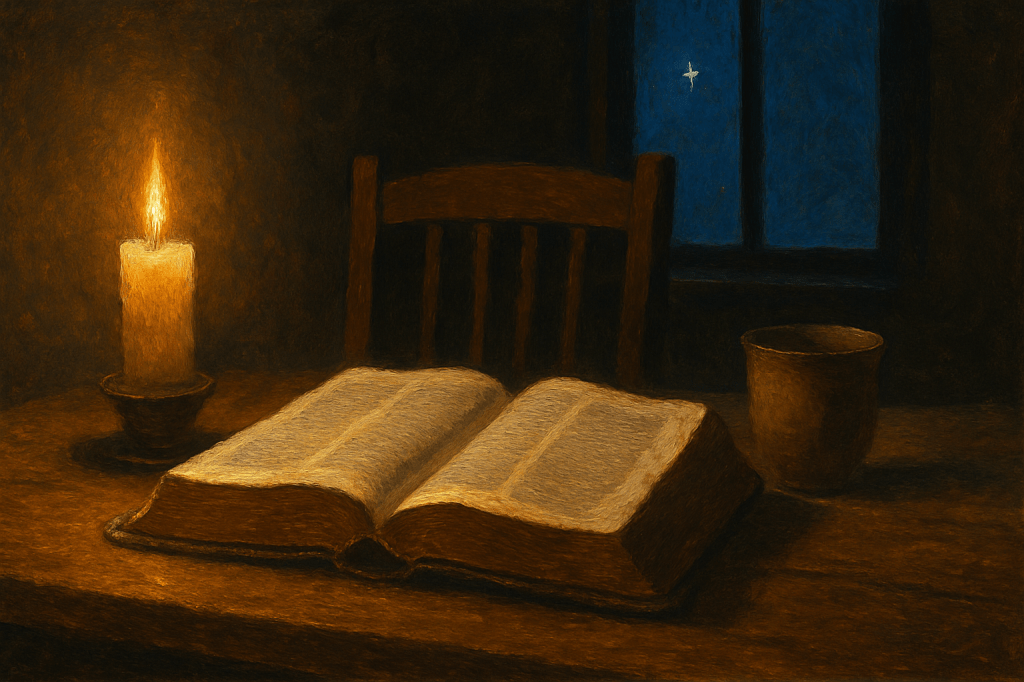
Eating His Word in This Present Age
If there is one theme that has pressed most on my heart in these days, it would be this: the Marriage Supper of the Lamb is not a distant event in heaven – it is an invitation right now. And that invitation is not abstract. It is very concrete: will you feed on the Word of God as your daily food, in love and obedience to Jesus?
When Jesus restored Peter after his denial, He did not ask Peter, “Are you ready for ministry?” or “Will you build a big church?” He asked one question three times: “Do you love Me?” And each time, He tied Peter’s love directly to feeding and tending His lambs and His sheep.
If we say we love God, that love must express itself in very real ways:
- We love God by listening to Him.
- We love God by receiving what He speaks.
- We love God by feeding on His Word and then feeding others.
This is why I have come to see the Marriage Supper of the Lamb as one of the most important messages for this hour. It is about how we love God with all our heart, soul, and mind, and how we will stand in the time of testing that is ahead.
“You shall love the Lord your God with all your heart and with all your soul and with all your mind. This is the great and first commandment.”
– Matthew 22:37–38
Whatever we call “most important” in this article must be rooted in these two great commandments: love for God and love for one another. Everything that follows is meant to serve that love.
Marriage vs the Marriage Supper
In an ordinary wedding, we all understand the difference:
- Many guests attend the wedding supper.
- But only the bride actually goes into the marriage chamber with the groom.
The supper and the marriage are related, but they are not the same event. One is a public celebration; the other is a private union.
I believe Scripture treats the Marriage Supper of the Lamb and the marriage itself in this same way:
- The marriage supper is the season in which we are now invited to come, sit, and eat what God sets before us.
- The marriage—the final union, the unveiling of the Bride—takes place at the end of this age, when the dead in Christ are raised and we are given new and perfect hearts: the consummation of God’s own heart and Spirit with ours, so that we perfectly reflect His love and character.
In this first article, I want to focus on the supper: what it is, what we are eating, and why so many refuse the invitation.
The Parable of the Great Banquet: An Invitation Ignored
Jesus gives us a picture of this in the parable of the great banquet:
“16 But he said to him, “A man once gave a great banquet and invited many. 17 And at the time for the banquet he sent his servant to say to those who had been invited, ‘Come, for everything is now ready.’ 18 But they all alike began to make excuses. The first said to him, ‘I have bought a field, and I must go out and see it. Please have me excused.’ 19 And another said, ‘I have bought five yoke of oxen, and I go to examine them. Please have me excused.’ 20 And another said, ‘I have married a wife, and therefore I cannot come.’ 21 So the servant came and reported these things to his master. Then the master of the house became angry and said to his servant, ‘Go out quickly to the streets and lanes of the city, and bring in the poor and crippled and blind and lame.’ 22 And the servant said, ‘Sir, what you commanded has been done, and still there is room.’ 23 And the master said to the servant, ‘Go out to the highways and hedges and compel people to come in, that my house may be filled. 24 For I tell you, none of those men who were invited shall taste my banquet.’”
– Luke 14:16–24
Notice a few things:
- The banquet is ready now – “Come, for everything is now ready.”
- Those first invited are not atheists. They are not shaking their fist at God. They are simply busy. Their hearts are bound up with land, work, possessions, family.
- The master still wants a full house. If some will not come, he will fill his house with others.
Now ask a simple question:
If this parable were about a sudden rapture to a wedding banquet in heaven, who would say no? Who would reply, “I just bought some land,” or “I just got married – I can’t come”?
No one would.
This parable makes sense when you see the banquet as here and now. There is a real table set in front of us in this age. We have real excuses in this age. We are being invited now to the Marriage Supper of the Lamb.
The question is not, “Will you want to go to heaven one day?” The question is, “Will you come to the table today?”
What Is on the Table?
If the marriage supper is here now, the next question is:
What exactly are we eating?
Jesus answers that directly:
“So Jesus said to them, “Truly, truly, I say to you, unless you eat the flesh of the Son of Man and drink his blood, you have no life in you.”
– John 6:53
And a few verses later:
“Whoever feeds on my flesh and drinks my blood has eternal life, and I will raise him up on the last day. For my flesh is true food, and my blood is true drink. Whoever feeds on my flesh and drinks my blood abides in me, and I in him. As the living Father sent me, and I live because of the Father, so whoever feeds on me, he also will live because of me. This is the bread that came down from heaven, not like the bread the fathers ate, and died. Whoever feeds on this bread will live forever.”
– John 6:54–58
Jesus connects this directly to the manna God gave Israel in the wilderness:
“And he humbled you and let you hunger and fed you with manna, which you did not know, nor did your fathers know, that he might make you know that man does not live by bread alone, but man lives by every word that comes from the mouth of the Lord.”
– Deuteronomy 8:3
And when Satan tempted Him in the wilderness, Jesus answered with this same verse:
“It is written, “‘Man shall not live by bread alone,
but by every word that comes from the mouth of God.’”
– Matthew 4:4
Scripture itself ties these threads together:
- The manna in the wilderness was a picture – a cast and shadow – of Jesus Himself, the true bread from heaven.
- Jesus is called “the Word”:
“And the Word became flesh and dwelt among us, and we have seen his glory, glory as of the only Son from the Father, full of grace and truth.”
– John 1:14
So when Jesus says, “Whoever feeds on my flesh…”, He is not inviting us to some strange ritual. He is telling us plainly:
Jesus is telling us that real life is found in feeding on the Word of God as our true food, just as Israel fed on manna every day.
The Marriage Supper of the Lamb is, at its core, this:
Sitting down daily with the Word of God – the pure, unleavened Scripture – and receiving it into your heart in faith.
That is what it means to “eat His flesh.”
Contempt for Manna and the First Falling Away
Israel was required to gather manna every day (except the Sabbath). At first, they marveled at it. But over time, they grew tired and began to despise it:
“For there is no food and no water, and we loathe this worthless food.”
– Numbers 21:5b
When they called the manna “worthless food,” the Lord sent fiery serpents among them, and many died (Numbers 21:5–6).
Today, many treat large parts of Scripture – especially the Old Testament – as “worthless food.” Some even speak as if it were optional or outdated. Others simply do not bother to open their Bible at all, except occasionally.
In John 6, after Jesus spoke about eating His flesh and drinking His blood, something remarkable happens:
“After this many of his disciples turned back and no longer walked with him.”
– John 6:66
It’s striking that the first great falling away did not happen when Jesus was doing miracles. It happened when His words became offensive and too hard to accept. When the “food” He offered was no longer to people’s taste, they walked away.
It has always struck me that this hard saying lands at John 6:66. I personally see in that a foreshadowing of the great falling away that will accompany the rise of the beast and his mark at the end of this age.
It’s easy for us today to say we are following Christ, while quietly refusing to eat His flesh and drink His blood in the way He means. It’s easy to accept blessings and promises, but not the offense of the cross, not the daily discipline of opening the Word, and not the correction and reproof His words bring.
When the time of tribulation comes and the cost of following Christ becomes severe, those who have not been eating at the marriage supper – who have not been feeding on Jesus through His Word – will find themselves weak and starving spiritually.
“11 Behold, the days are coming,” declares the Lord God,
“when I will send a famine on the land—
not a famine of bread, nor a thirst for water,
but of hearing the words of the Lord.
12 They shall wander from sea to sea,
and from north to east;
they shall run to and fro, to seek the word of the Lord,
but they shall not find it.
13 “In that day the lovely virgins and the young men
shall faint for thirst.
14 Those who swear by the Guilt of Samaria,
and say, ‘As your god lives, O Dan,’
and, ‘As the Way of Beersheba lives,’
they shall fall, and never rise again.”
– Amos 8
Listening as an Act of Love
We often talk about loving God in emotional terms, but Jesus ties love to very concrete actions:
- “If you love Me, you will keep My commandments.”
- “If you love Me, feed My lambs… tend My sheep… feed My sheep.”
Listening to our Heavenly Father is an act of love and respect. When you pick up your Bible each day and open your heart, you are saying to God:
“Father, Your words matter to me very much.
I am here to listen, to understand, and to please because I love You.”
You are also loving your neighbor, even though they are not in the room, because:
- We cannot feed lambs if we ourselves are starving.
- We cannot tend sheep with truth if our own heart is empty of truth.
- We cannot help others stand in the time of deception if we are not rooted in the Word ourselves.
Coming to the table of the Marriage Supper of the Lamb, day after day, is one of the most real ways you can fulfill the two great commandments:
- Love the Lord your God – by listening, believing, and obeying His Word.
- Love your neighbor as yourself – by becoming someone who can feed and strengthen others with that same Word.
How to Come to the Table Each Day
This first article would be incomplete if it only spoke in theory. The invitation is practical. Here is a simple pattern you can follow.
You do not need to copy my way exactly, but I will share what I try to do.
Come through the sacrifice
I begin by remembering that I only come to God through the blood of Jesus. I do not come as a good man who had a good week. I come as one who has been washed and forgiven.
A simple prayer might be:
“Father, I come to You only by the blood of Your Son.
Thank You for His sacrifice.
Cleanse my heart and my conscience as I draw near.”
Come with a real heart, not a performance
I try to come honestly:
- If I am tired, I tell Him I am tired.
- If I am anxious, I confess my anxiety.
- If I am dull, I ask for mercy and awakening.
- If I am struggling with temptation, I admit my weakness and invite Him to change me.
The point is not to put on a show for God, but to be honest and transparent and open your heart to Him.
Open the Word and expect Him to speak
I then open my Bible and read – not as a religious duty to “get through” a chapter, but as a hungry man sitting at a table.
A few practical helps:
- Let God set the menu: over time, give equal attention to all parts of Scripture, not only your favorite passages.
- When a verse cuts you, do not run away. Stay with it.
- When something is hard to understand, do not shrug and move on. Ask: “Father, I do not understand this. Please teach me by Your Holy Spirit.”
Sometimes the understanding comes quickly; sometimes it takes days or even years. The important thing is to hold the question in your heart until He gives you the understanding.
Let the Word change you
If we are truly eating the flesh of Jesus, His Word will not simply confirm everything we already think. It will change us. Often that means being challenged, humbled, and called to realign our thinking and obey. That is a sign that the Word is alive in us.
Share what you are eating
Finally, when the Word really begins to feed us, it changes our everyday focus and how we interact with others. We realize how important God’s life-giving words are in a world marked by spiritual darkness and find ourselves wanting to share what He has shown us. We listen, we pray inwardly for discernment, we test for an opening with a sentence or two, and if there is an open door, we speak up.
In this way, what we receive at the Marriage Supper moves naturally from His heart into ours and then out toward others.
The kingdom of heaven is like leaven that a woman took and hid in three measures of flour, till it was all leavened. -Matt 13:33 (ESV)
A Preview of What Comes Next
In this first part, we have focused on “eating His flesh” – receiving the Word of God as our daily food in this present age. The Marriage Supper of the Lamb is not a theory; it is the daily choice to come to the table, open the Scriptures, and let God speak to our mind and heart.
In Part 2 – Drinking His Blood, we will look at how the Holy Spirit makes this Word alive in us: the difference between letter and Spirit, the picture of water turned to wine, the table of the Presence and the lampstand, grain with oil and without it, and the ten virgins who either carry oil or find themselves shut out.
In Part 3 – The Bride’s Offspring, we will turn to the marriage itself and its fruit: the Bride’s fine linen as righteous deeds, cross-bearing and the Bridegroom of blood, the soil of our hearts, the parable of the sower, and how the Bride is washed by the Word and brings forth offspring for the Bridegroom.
For now, the question remains very near: are we actually coming to the table today?
The invitation is on the table.
Come and eat.
 The Heart of a Lion