A Love Song to War and a Mocking Gospel
“Riders on the Storm” is a message about war and judgment—a song that says, in effect, the storm is coming, the riders are already in motion, and the only real shelter is the One most people refuse to love.
The original track is here, and a well-known fan edit set to Vietnam War footage is here.
Like the other songs we’ve looked at, I believe it also carries a mocking tone: Satan gloating that he can speak truth right in front of us, and almost no one notices.
“Riders on the storm” – Spiritual cavalry
The song opens with the repeated phrase “Riders on the storm.” Before I dive in, it’s worth asking: who are the riders?
Isaiah 21 gives a clue. The prophet is told to set a watchman, and the watchman reports what he sees:
“…riders, horsemen in pairs, riders on donkeys, riders on camels…” (Isaiah 21:7)
In the ancient world, horses, donkeys, and camels were the vehicles that carried soldiers, weapons, and supplies to the front lines. In our day the hardware has changed—trucks, trains, planes, ships—but the pattern is the same. When you see massive movement of men and materiel toward a front, you are watching the riders of war.
Those are the riders of the storm in the physical sense: columns of troops, endless convoys, logistics chains feeding a conflict that has its own momentum once it starts.
But that is only the surface.
The track itself is soaked in rain and thunder. Musically and lyrically, the picture is:
- A dark sky,
- Sheets of rain,
- Invisible riders moving through it.
This echoes the biblical picture of war and judgment moving like a storm across the earth—like the horses released in Revelation 6, or the “whirlwinds” and “riders” of Isaiah 21 sweeping through nations.
The riders are not just tanks and soldiers. They are spiritual powers riding on top of human wars—principalities and powers that push nations into conflict and feed on the destruction.
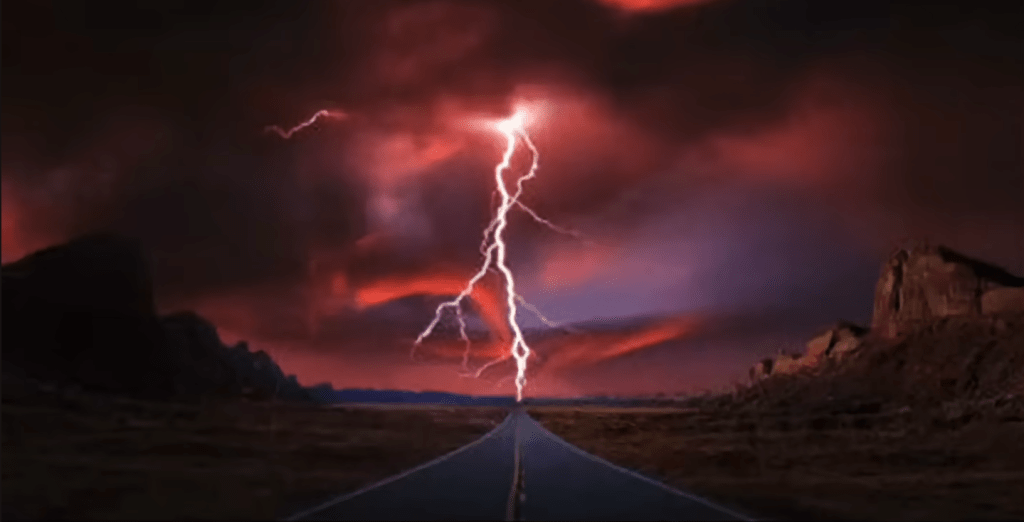
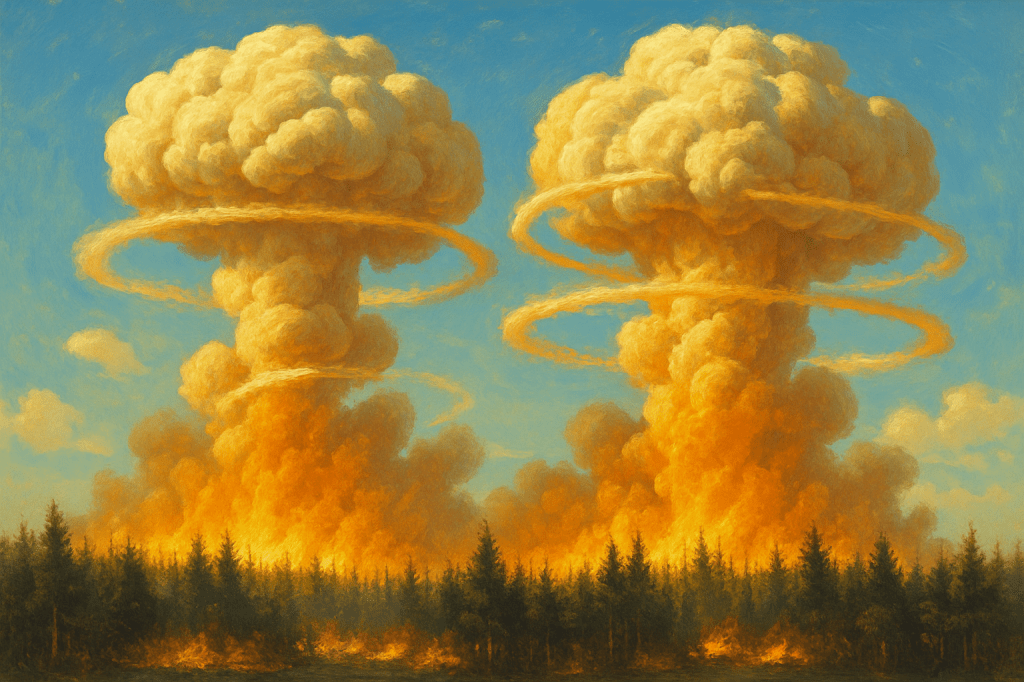
The official audio visualizers lean into the storm mood. And in the Vietnam-war fan edit, the lightning flashes line up with artillery and bombs, making the link even clearer: the storm is not just weather; it is war.
The song never names these riders. It just keeps chanting the line, like a mantra: the riders are out there, and the storm is already on us.
“Into this house we’re born… into this world we’re thrown”
Early in the song we hear two key lines:
- “Into this house we’re born…”
- “Into this world we’re thrown…”
We are born into a storm-world—into a “house” already under judgment. The Bible says creation itself is in “bondage to corruption” and “groaning together” (Romans 8:21–22). Human life begins in a broken system.
The next images underline that:
- A human being “like a dog without a bone” – restless, unsatisfied, wandering, looking for something to cling to.
- “An actor out on loan” – on stage for a short time, reading lines someone else has written, then gone.
That is the human condition under the ruler of this age. People are hungry, temporary, and easily pushed into playing parts in someone else’s drama—especially the drama of war.
The storm is already raging when we arrive. Most of us just try to live our small stories under a sky filled with riders.
“There’s a killer on the road” – War personified
The tone shifts when we hear: “There’s a killer on the road.”
On one level, you can picture a serial killer. On another level, it is a picture of war itself, personified—a spirit of murder travelling the highways of history.
His “brain… squirming like a toad” sounds like an unclean spirit: restless, slimy, never at peace, always hunting for the next victim.
Then comes a chilling warning in everyday language:
If you give this man a ride, sweet family will die.
This is the dance of war. Once you invite war into your vehicle—your nation, your alliances, your political project—it does not just hurt “the other side.” It kills families on every side:
- Sons drafted and sent to the front.
- Daughters trafficked or abused.
- Cities leveled.
- Fathers and mothers buried or left nameless.
It echoes the red-shoes picture from Hans Christian Andersen: once you put them on, you cannot stop dancing. Once you let the killer in the car, you cannot control where he takes you. The dance continues long after people want it to stop.
In that sense, the rider is not just a single man. He is the spirit of war—and behind him, the destroyer who has been riding storms from age to age.
“Take a long holiday… let your children play” – Stepping Out of the Storm’s Path
Around this same section we hear:
Take a long holiday
Let your children play
On the surface it can sound like escapism—go someplace warm, let the kids enjoy life. But in light of Scripture’s warnings, I hear something sharper: get out of the path of the storm while you still can. Revelation 18:4 says, “Come out of her, my people…” and Jeremiah repeatedly calls people to flee from the city under judgment rather than sit and hope it blows over.
In that light, “take a long holiday” carries a dark double meaning—not a long weekend, but a one-way trip out of the kill zone. And “let your children play” is not about ignoring reality; it is about preserving your children’s lives so they can live to play at all. School, careers, routines—none of that matters if a bomb lands on your city. When God says to leave, the priority is simple: go.
In our own time, we have already seen what happens when people wait too long. Millions of Syrians have been scattered across neighboring countries because the war swallowed their towns faster than they ever imagined. Millions of Ukrainians have left homes, jobs, and schools behind and become refugees across Europe. Before the full-scale invasion, many thought, “It probably won’t come to my city. It will blow over.” For some, that delay meant getting trapped—men called up to the front lines, families separated, or only being able to flee with what they could carry.
The same pattern showed up in Vietnam: millions of civilians killed or wounded, and millions more driven from their homes. No one set out hoping to become a war refugee, but once the storm was fully overhead, many had no choice.
Biblically, God has already told us how serious the final storms will be. In Isaiah, when the prophet asks, “How long, O Lord?” he is told it will be “until cities lie waste without inhabitant… and though a tenth remain in it, it will be burned again” (Isaiah 6:11–13, excerpts). Elsewhere we read: “seven women shall take hold of one man in that day” (Isaiah 4:1, excerpt)—a picture of how badly war will thin the ranks of men (and also a shadow of the seven churches finally clinging to one Man, Jesus.
I do not know the exact timing, but I believe World War III and the night that is coming will be devastating. It will not all happen in a single instant; Scripture hints at an ordered sequence of blows. In other articles I will dig into Illuminati symbolism that points to specific cities marked for early destruction, such as I have already done in Marks & Spencer Xmas Advert Exposed. For now, the point is simple: when the song says, “Take a long holiday,” I hear more than vacation lyrics. I hear a warning—move before the riders of the storm arrive at your door.
“Girl, you gotta love your man” – A buried gospel
Then, out of nowhere, comes a different kind of stanza:
Girl, you gotta love your man…
Take him by the hand…
Make him understand…
The world on you depends…
Our life will never end…
On the surface, it sounds like a strange love song. But listen carefully.
In Scripture, the true people of God are called the Bride of Christ. Jesus is the Bridegroom; the Church is the “girl.” Eternal life hinges on whether she loves Him, takes His hand, and stays faithful.
- “The world on you depends” – in a real sense, the fate of nations hangs on whether the people of God remain loyal to Jesus or sell out to Babylon.
- “Our life will never end” – that is the heart of the gospel promise: “whoever believes in him should not perish but have eternal life” (John 3:16).
I believe this is Satan mocking the gospel in plain sight.
It is as if he is saying to God:
“Look—I told them the truth right in the middle of a song about war. I told them the girl has to love her man, that eternal life depends on it. They sang along, stoned and distracted, and never heard it. Can I burn them now?”
The truth is there. Most listeners never connect it to Jesus.
Back to the Storm – The Only Shelter
After the “girl, you gotta love your man” stanza, the song slides back into the storm. The riders keep moving, the rain keeps falling, the refrain circles round and round.
“There will be… wars and rumors of wars… nation will rise against nation, and kingdom against kingdom” (Matthew 24:6–7, excerpts).
What’s missing is any real shelter—no ark, no rock, no strong tower named. The picture is simple and bleak: wars will come, killers are on the road, families will die, and you might as well drift through it half-awake, humming along. From Satan’s point of view, that is perfect. As long as people never look up, never call on the name of Jesus, the storm will sweep them away.
Scripture gives a different way to respond. God does tell His people to leave when judgment is coming—“Come out of her, my people…” (Revelation 18:4)—but not as a project of clinging to this life at all costs. Jesus said, “whoever would save his life will lose it, but whoever loses his life for my sake will find it” (Matthew 16:25). The point is not survival for its own sake; the point is obedience and trust. Sometimes He hides His people—“perhaps you may be hidden in the day of the anger of the LORD” (Zephaniah 2:3)—and Daniel is told there is blessing for “the one who waits and reaches the end” (Daniel 12:12, excerpt). Sometimes He calls us to be “faithful unto death” with the promise of “the crown of life” (Revelation 2:10, excerpt). In every case, real safety is being in right relationship with God and letting Him steer your steps—even where you live, even when it is time to go.
There really are riders on the storm. There really is a killer on the road. And there really is a “girl” whose love for her Man will never end—the Bride who takes Jesus by the hand, makes Him understand (by her obedience) that the world on her depends, and discovers that in Him her life truly never ends. The song tells the storm honestly but leaves the shelter unnamed. The question it leaves us with is simple: will we stay in the path of the storm with the killer, or step out of the car and into the hands of the only One who can carry us through it into eternal life?
“Everyone then who hears these words of mine and does them will be like a wise man who built his house on the rock. And the rain fell, and the floods came, and the winds blew and beat on that house, but it did not fall, because it had been founded on the rock.” (Matthew 7:24–25)






 The Heart of a Lion