Dear Friends,
These are the new articles this week:

Site Map: A simple overview of the site, with every article listed and grouped by theme.
Blessings to all of you who have the heart of a lion.
— Leonard
Morning comes, but also night. If you will inquire, inquire; turn back and come.
Dear Friends,
These are the new articles this week:
Site Map: A simple overview of the site, with every article listed and grouped by theme.
Blessings to all of you who have the heart of a lion.
— Leonard
Don McLean’s “American Pie”: The Deep Decode
In Part 1 I argued that American Pie is not just a nostalgic song about the 1960s, but a prophetic warning about the fall of America—Rome burning in modern clothes. Don McLean himself now says that politics and music flow together in the song, and that the verses grow “more dire” all the way to the end. I also introduced the “deleted verse” with its five-year marker, and why I believe that timing could only have come from God.
In Part 2 we looked at Madonna’s American Pie video. Her version is shorter, and the story told by the symbolism is direct and easy to follow. It exposes some of the basic alphabet of the code: numbers like 101, 1:59, 6 vs 7, 13, and 66, along with key images tied to the coming of the antichrist and the New World Order.
The McLean video picks up where Madonna’s leaves off. It deepens the meaning of those symbols and gives a far more detailed picture of America’s coming collapse and the events leading up to it. Because of that added depth, I have split my discussion of the McLean video into two parts: this Part 3, Don McLean’s “American Pie”: The Deep Decode, and Part 4, What This Says About America’s Future.
If you grew up with Captain Crunch cereal, you know what I mean when I say this video is, to me, the Captain Crunch decoder ring of Illuminati symbolism. Not only do the symbols appear conspicuously, but the video also includes some of the key information needed to understand and confirm their meaning. It is the oldest video I know of that uses this full symbolic system—and after it, the same code shows up in many mediums all over the earth.
We start with what the video makes impossible to miss: the number 59.
At 0:59 into the McLean video, there is a conspicuous “59” on the pavement. It is framed so the viewer’s eye lands on it, and the timestamp matches it. That kind of precision is the video telling you, Pay attention—this number matters.
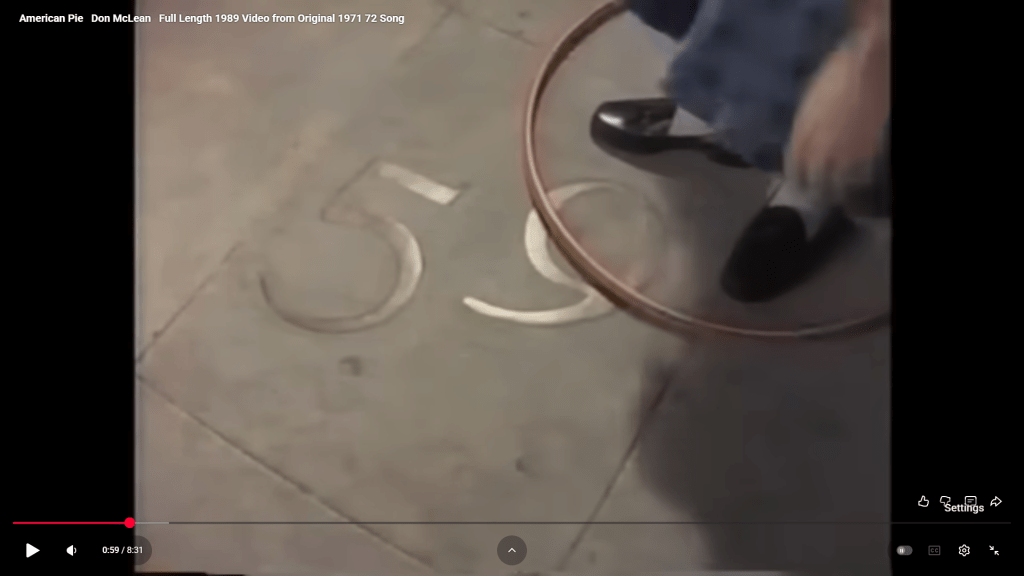
In that same shot, a hula hoop circles a pair of black shoes, emphasizing the footwear as part of the marker—not just the digits.
At 2:55, there is another pavement marker. At first glance it reads like a “65,” but the motion of the frisbee hints the number is meant to be rotated, revealing it as “59.”
Here the frisbee lands near red shoes, pairing red with the earlier black and reinforcing the same red/black duality we established in Part 2 as colors tied to New World Order. I’ve rotated the image to make the “59” easier to see.
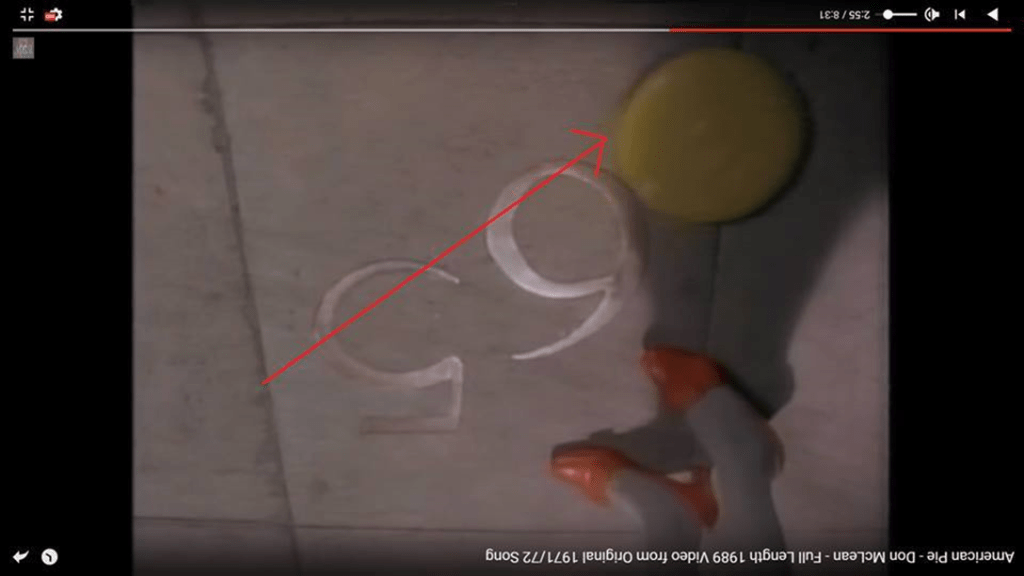
If the video is deliberately signaling “59,” the next question is: what does 59 mean?
I found a meaning answer to this question through the use of “simple gematria”. In simple gematria, each letter is assigned a value (A=1, B=2, C=3 … Z=26), and the values are summed. Using that method, “59” can be attached to specific identities/attributes that appear in the story.
“59” is the simple gematria value for “Joker”, “Shiva” and “Negro” and each of those words is then reinforced by the imagery in the video. You can verify the values here:
First, Joker. There are two scenes—one beginning at 2:24, and another beginning at 4:54—that show the Joker (or Jester) pulling pranks and winning over the heart of the “queen” (America). To understand the analogy, hold it up to the lyric frame: “When the jester sang for the king and queen.”
In this decode, the king is God—because the antichrist’s project is ultimately a global rebellion of man against God. And the queen is the heart of America, the harlot of Revelation, who says in her heart, “I sit as a queen” (excerpt from Revelation 18:7).
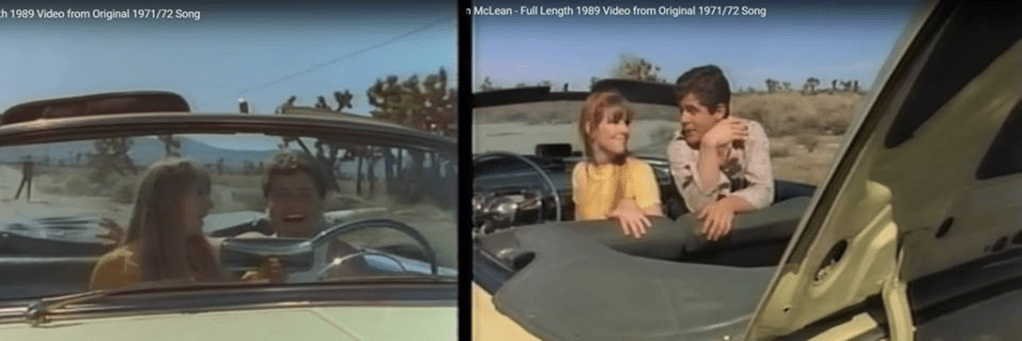
In the first scene, the first boy—representing a legitimate government—pushes the car forward to get it started again, with the car symbolizing the nation’s path. When it starts, the boy falls, and the Joker drives away with the girl. In the second scene, while the “legitimate” side is trying to fix a flat tire, the Joker grabs a bottle of rum and runs away with the girl to intoxicate her.
As I pointed out in Part 1, McLean ties the song to U.S. politics, and indicates that the “jester” is an actual person—not just an abstract idea, and not James Dean.
Those two sequences confirm the “Joker” meaning attached to the “59” tag.
Next, Shiva: At 4:27 there are cheerleaders in a Shiva-style pose. Since the cheerleaders’ arms and legs appear semi-transparent—an artifact consistent with the limitations of CGI at the time—it’s clear this “multi-limbed” look was constructed, not casually captured. That extra effort is part of what makes this moment read like a deliberate symbol rather than an ordinary cheer pose.
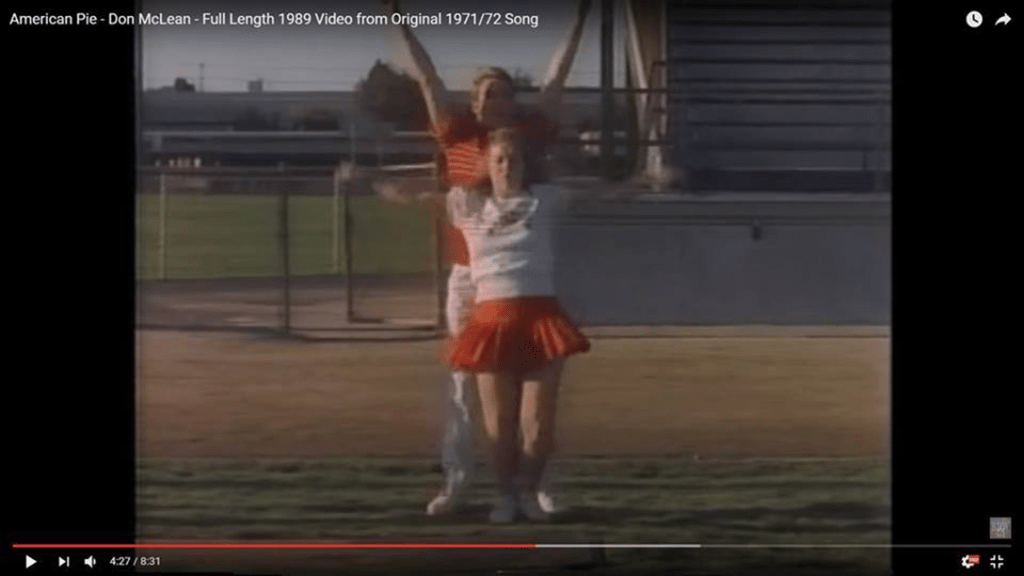
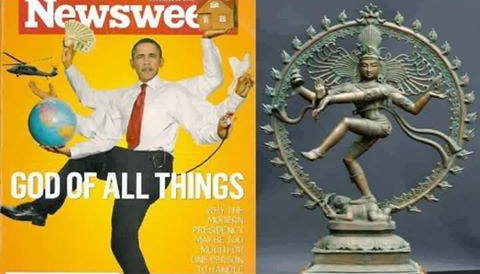
Shiva is a Hindu deity commonly associated with destruction and transformation, and in modern symbolic messaging this motif often functions as “rebirth through destruction.” I mention this here because the same symbol shows up repeatedly across unrelated media, which is one way this code signals that it is a system rather than a one-time artistic flourish.
Shiva is also used as a public-facing symbol connected to CERN (via the Shiva statue), which— as I briefly touched on in Marks & Spencer Xmas Advert Exposed—many believe is tied to opening the “abyss” imagery of Revelation 9:1-2.
The following image depicts Obama as Shiva, and shows the CERN Shiva statue:
Finally, Negro: At 3:42 into the video we see a Black man is shown looking in through a window. I’m using the word “Negro” here only because it is the gematria term being signaled by the frame and the era of the video—not as a slur.
At first glance, the scene can look like racial exclusion: the man is outside, and the people inside appear to be white, while the lyric line is on “dirges in the dark.” But on closer inspection, the sign reverses the first impression. It reads: “NOBODY CAN BE BROUGHT TO THESE PREMISES.” I enlarged and mirrored the frame below to make the lettering easier to read.
Note: in the current version of the video, this signage is no longer readable in the same way; the still below is from an earlier version.
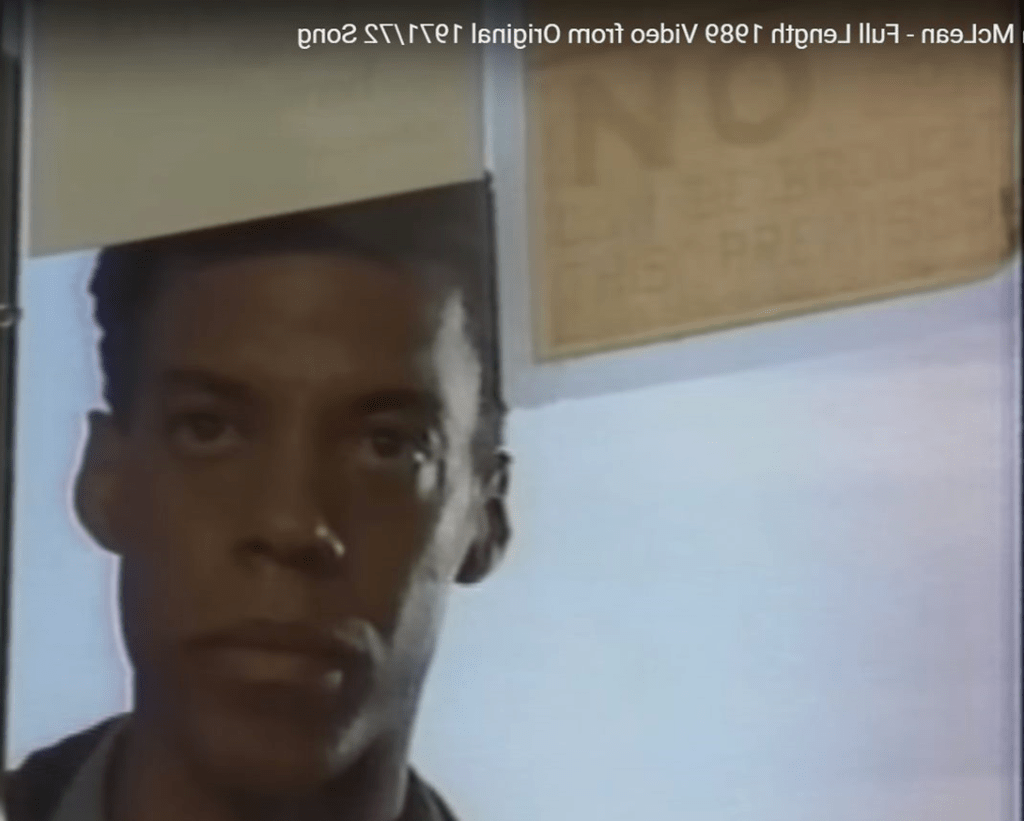
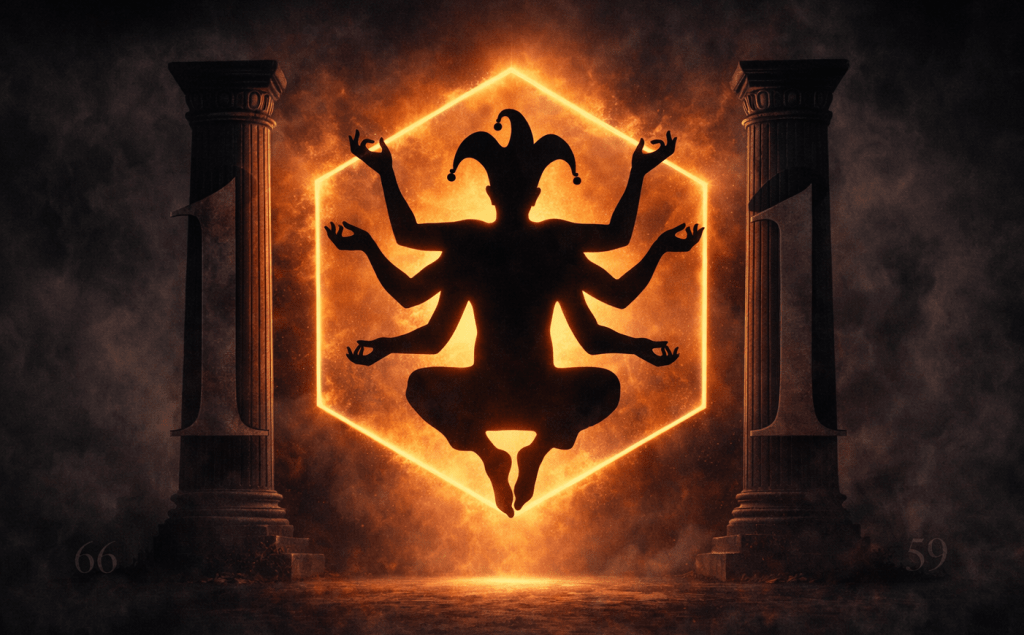
Now “59” is no longer just a number. In is a framework, it becomes a label for a specific composite portrait—the Joker / Shiva / Negro identity for the antichrist figure.
Beyond gematria, there is another reason “59” fits as a numeric “mark” inside this symbolic system: it is the 17th prime number. And 17 functions as a compact beast-marker because Revelation 13 describes “a beast rising out of the sea, with ten horns and seven heads” (Revelation 13:1, ESV). Seven heads plus ten horns/crowns yields 17, which is why “17” is repeatedly used in this code to point back to the beast. “59,” as the 17th prime, then becomes a natural candidate for a recurring numeric tag. In this read, that same beast later turns on the harlot who rides it (Revelation 17) and establishes what is commonly called the New World Order.
Not convinced yet? We are just scratching the surface.
Now we build one step deeper—because 59 often appears with a “1.”
I already touched on this in Part 2 with the 1:59 marker in Madonna’s video (the demon-birth moment). Now I will connect this “1” to the “little horn” language of Daniel 7 and Daniel 8.
Below is Yale’s Skull & Bones emblem. The reason it belongs here is because it includes the same “1 + 59” pattern we’ve been tracing.
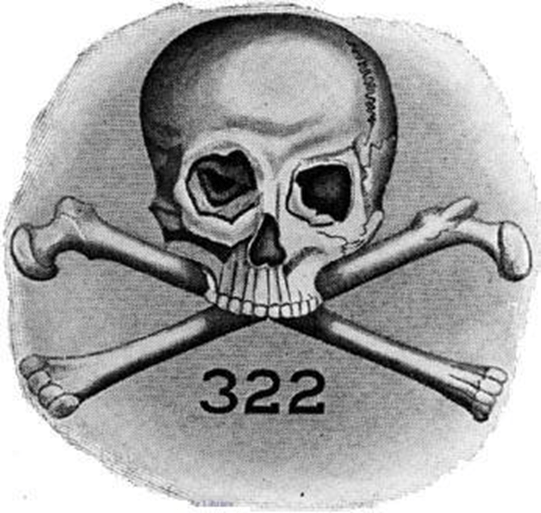
I include a fuller breakdown of the many messages embedded in this emblem at the end of this article. In short, I read it as pointing to global conflict that culminates in the rise of the antichrist and a rebellion of man against God.
Here, I’m focusing only on the numerical structure.
Starting with what stands out most, there is an obvious 322 printed at the bottom.
Next is an 11/6 pattern. This is discerned by counting the teeth: there are eleven in total, and six of them are noticeably longer. That tells you the emblem is meant to be read numerically, and it also hints at how the “1 + 59” pattern is encoded.
Now look at the ends of the crossbones—where “knees” would be—marked by small nubs. In this read, there are nine nubs in total, and five are longer, yielding a 5 and a 9—a “59.” That count is not as obvious as the printed 322, but it fits the same numerical method suggested by the teeth.
And one detail seals the intent: on the top-right crossbone, one nub is conspicuous and extra long. That standout nub functions as the little horn marker—the “1” placed into the “59,” giving a compact 1:59 signature.
There is much more symbolism in this emblem, and I walk through it at the end of this article for anyone who wants the fuller context. It took me two years to decode once I began recognizing the system.
With that groundwork laid, the McLean video then hits the viewer with the most loaded “1 + 59” placement in the entire piece.
At 5:19 into the video, the graduation / ceremony scene is staged as a procession.
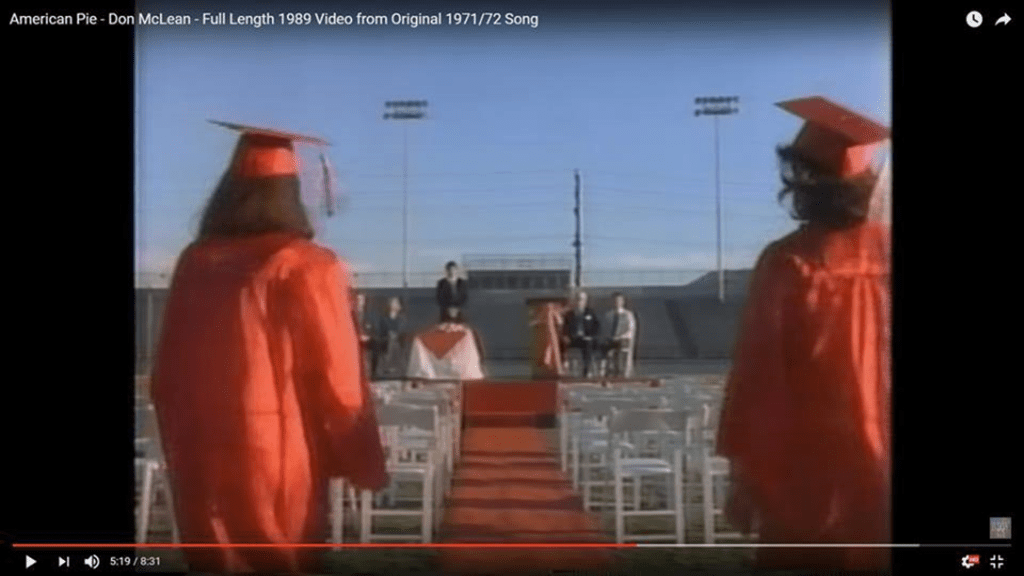
Upon closer examination, it reads to me as a ritualized march of sacrifices. We are nearing the lyrics:
Oh and as I watched him on the stage
My hands were clenched in fists of rage
No angel born in Hell
Could break that Satan’s spell
Notice the heart shape on the table to the left. It represents a sacrifice table. Notice the streams of red coming down from the podium—blood imagery. It represents a guillotine.
The students are dressed in red and are walking up a red carpet, representing blood sacrifices. The video then reinforces the sacrifice reading with a short sequence:
First, at 5:33, we see a girl looking up at the podium with a concerned look on her face.
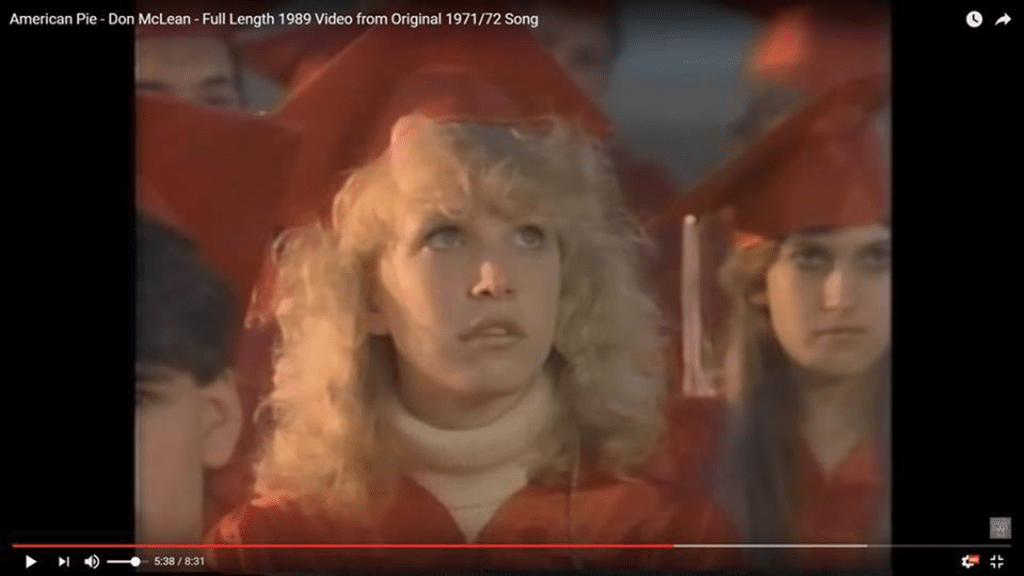
Then at 5:36, we see a boy standing in front of the table of sacrifice releasing a dove into the air—representing that he is letting go of his spirit, dying.
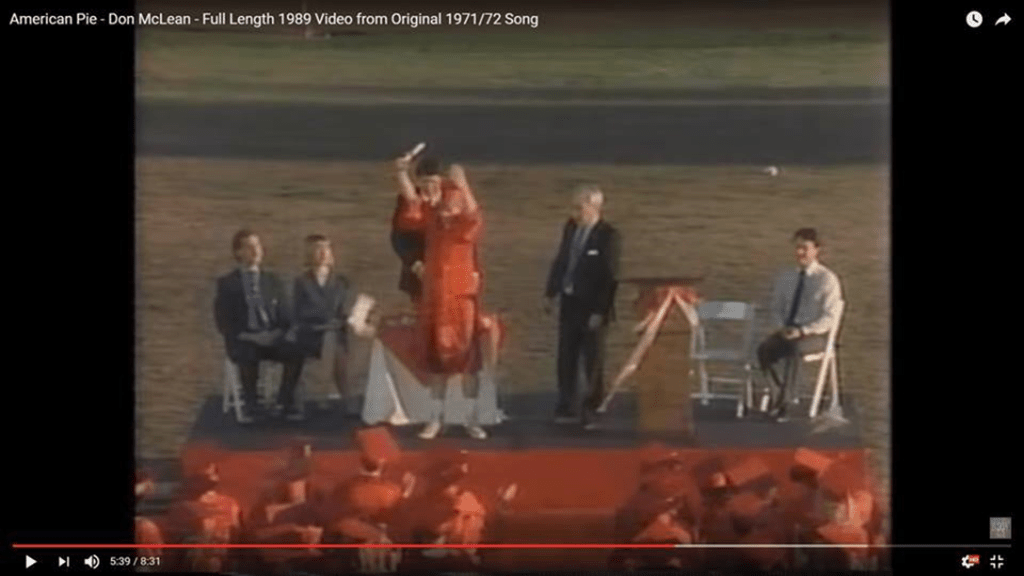
There is quite a bit more in the section of the video around “Jack be nimble, Jack be quick… ’Cause fire is the devil’s closest friend,” but we will dive into that in Part 4. Here I’m staying focused on the little horn and “59” symbolism.
The timestamp for the opening of this scene is 5:19—a “59” split by a “1.”
The little horn is placed in the middle of 59. This mirrors a pattern from Old Testament sacrifice:
And [Abram] brought him all these, cut them in half, and laid each half over against the other… As the sun was going down, a deep sleep fell on Abram. And behold, dreadful and great darkness fell upon him…. When the sun had gone down and it was dark, behold, a smoking fire pot and a flaming torch passed between these pieces
(Genesis 15:10, 12, 17)
God walks down the middle of Abram’s sacrifice in a dark night.
In this symbolic system, the “1” (the little horn) is walking down the middle of the divided sacrifice as the earth falls into that “dreadful and great darkness”—the night that comes before the Bright Morning.
So to summarize: the video clearly marks “59” as a special number. I have shown a system that fits both the video and the lyrics, giving “59” meaning through gematria as a set of characteristics attached to the antichrist—the little horn of Daniel 7 and Daniel 8. That also fits with how “59” is repeatedly paired with “1,” both in the McLean video and in Madonna’s (including the demon-birth moment at 1:59). I am unaware of any other explanation for why “59” is emphasized this heavily in this video—or why so many videos use 1:59 as a marker for destruction or antichrist birth. The American Pie videos were taken down for about three months after I first exposed these symbols and contacted McLean’s agent (as I described in Part 1).
So draw your own conclusion. If you’re still reading, it’s probably not because of skepticism anymore, but because you have the heart of a lion. These things are hard to look at. It is hard to imagine the evil lurking under the surface of so many icons of our society—and appearing again and again around the world.
This isn’t the last you will see of the little horn / “59” symbolism. It is all around us if you have eyes to see it. Now we are moving on to the 101 symbolism.
Just like the Madonna video strongly signals “101”, which we decoded in Part 2, the McLean video also strongly signals 101.
At 0:19 into the McLean video, a man walks past a church. The fuller examination of the video will reveal that this man represents Jesus. As he passes, the lyrics speak of music that “used to make me smile,” and of having “my chance” to “make those people dance.” The visual response is not joy. It is separation.
Alongside the church building, there are two tall, pillar-like bushes with a window between them forming a visual “101” pattern.
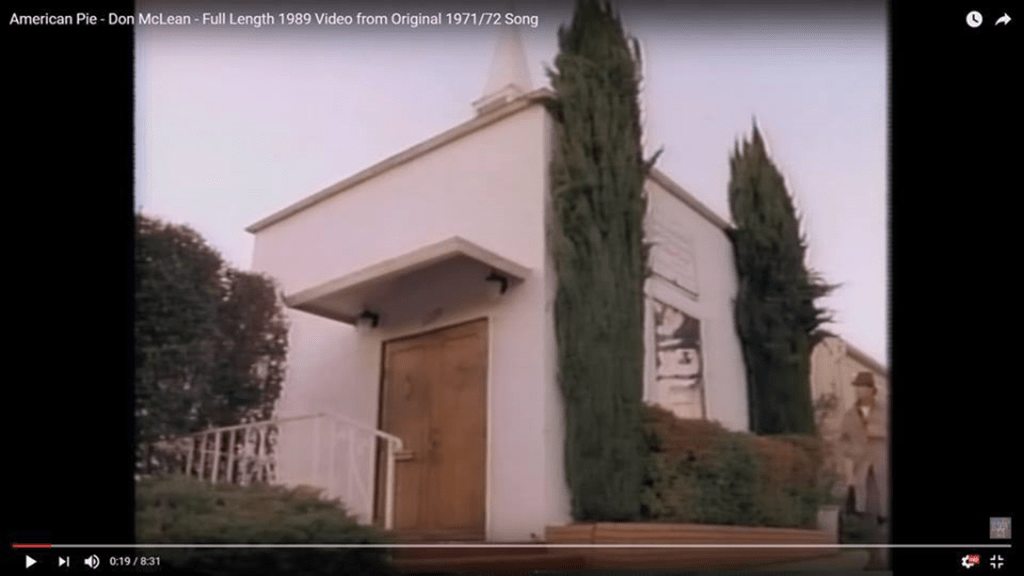
I recognized this pattern because when I lived in New Zealand, I lived across the street from a Freemason lodge. Here is a photo I took of this Freemason lodge in New Zealand.
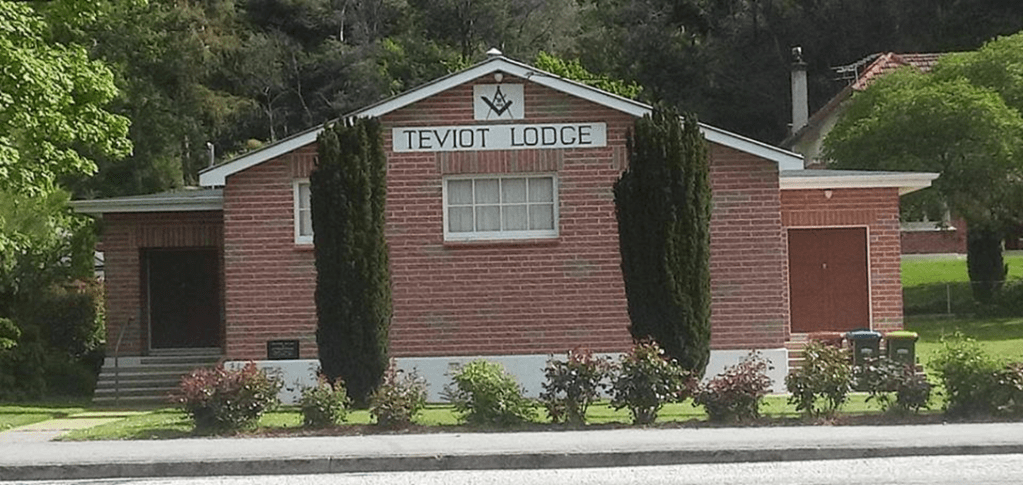
We will get to the actual meaning of 101 shortly, but here, the message is that another spiritual access point has been inserted alongside the church—something counterfeit, something hostile to true communion with God. That is why Jesus does not enter. He passes by.
Scripture warns repeatedly that shepherds and teachers will be corrupted, and that many will prefer comforting myths over truth (Jeremiah 23; Ezekiel 34; 1 Timothy 4:1–2; 2 Timothy 4:3–4). The McLean video places that warning right at the beginning: the church is there, but the gateway beside it is not the church’s friend. Specifically, my read (and my personal experience, which I will explain in Part 4) is that false doctrine planted by Freemasonry (which is subservient to the Illuminati, my reference for Satan’s highest level organization on this earth) has infiltrated U.S. churches. I believe this influence has been exerted institutionally through seminaries and denominational controls focused on garnering members and money, and on comfort-centered. We should not be surprised by Satan’s pressure on the churches to replace real relationship with God with feel-good religion.
At 1:01, the camera lands on a car priced at $599.
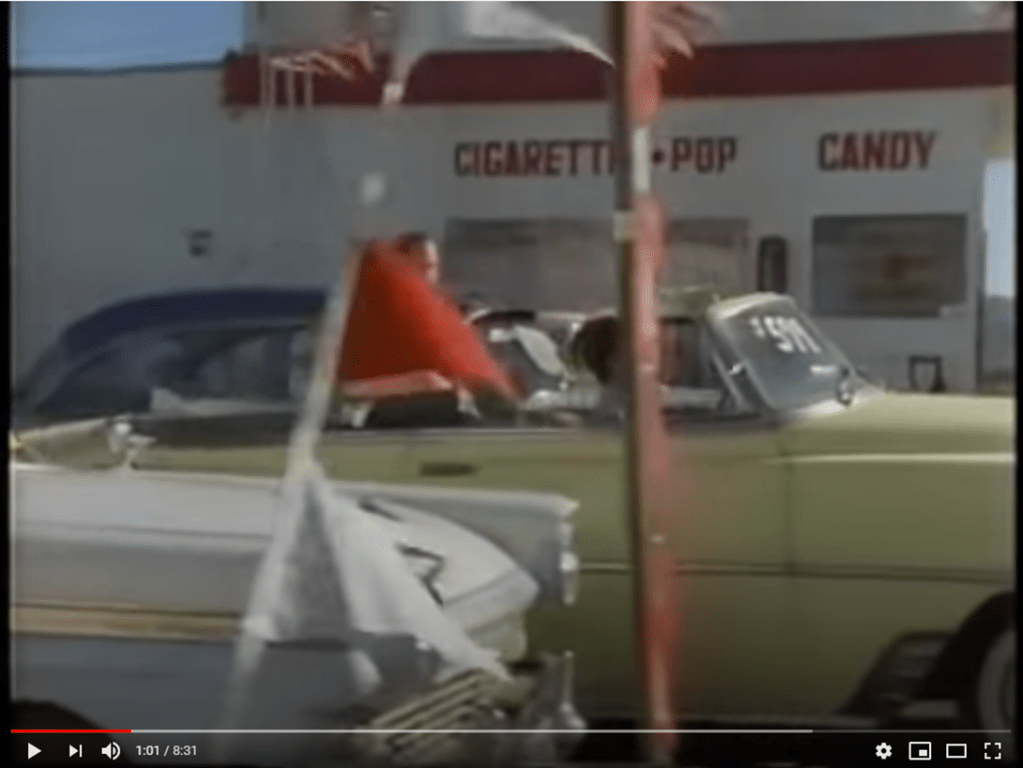
In this visual alphabet, 101 / lOl reads as pillar–portal–pillar: the “1” shapes function like uprights, and the “0” functions like an opening.
This does two things at once. First, the timestamp repeats the gateway marker (1:01). Second, the price $599 embeds the earlier numeric tag (59) inside the moment of 101—as if the video is saying: when the portal opens, this is what comes through. In the broader symbolic system, that gateway language is tied to temple ritual and sacrifice—a counterfeit “opening.”
And the “99” at the end is not just a price flourish. If you rotate the two 9s—as the video already signaled with the earlier 65→59 cue—they read as 66, tying back to the Ring of Six theme established in Part 2. The point is not that every viewer will decode every layer on the first pass. The point is that the video stacks 101 + 59 + 66 into a single beat: gateway imagery, the antichrist-identity tag, and the ritual language of “rebirth” through destruction.
At this point, it helps to step back and say plainly what this section is showing: this code isn’t confined to one music video. The same gateway marker appears across media and across nations—exactly as Scripture says:
“We know that we are from God, and the whole world lies in the power of the evil one.”
(1 John 5:19, ESV)
That’s why I include the next image.
On the main runway at Donetsk, the pro-Russian side painted a huge “#101″ beside a child silhouette. Locals were told it commemorated the number of children killed early in the conflict—but my friend who lives in Donetsk right on the border of the conflict informed me that the number of children killed was significantly higher. Rather the scale and styling read like the same global “101” signature: a portal mark stamped onto public space in the middle of war messaging.
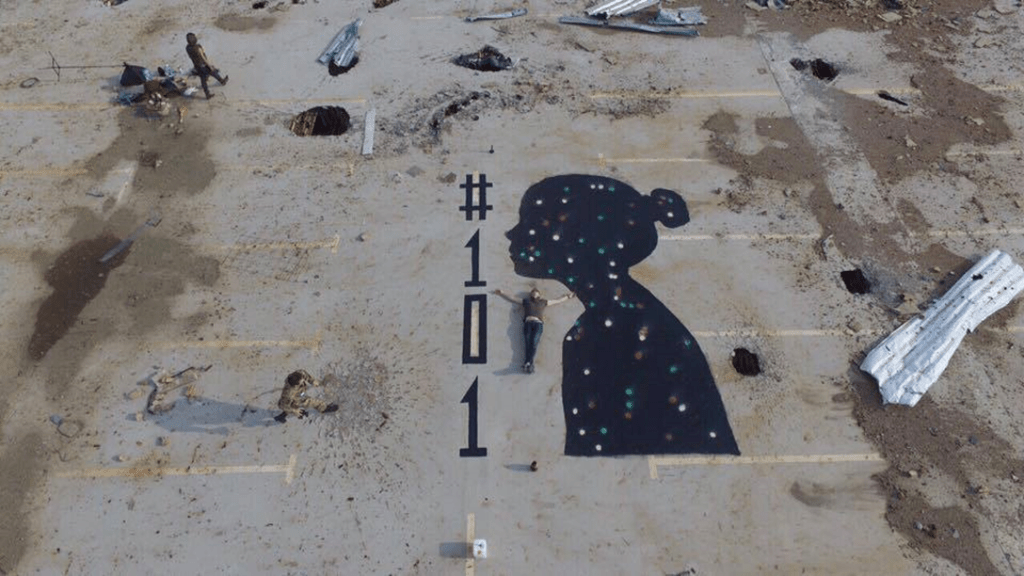
The silhouette is filled with many dot-marks; I believe there are 59 of them. The figure on the ground also appears arranged in a cross-like shape. Taken together, that reads as another “101 + 59” pairing—again linking the gateway marker with the same identity tag we traced in the McLean and Madonna videos. And it shows that this pairing appears on both sides of a global conflict—reinforcing the point of 1 John 5:19: the whole world lies in the power of the evil one. It also fits the conquest pattern Scripture describes—power expanding across nations under a single unseen drive (Revelation 6:1–2): the white horse of conquest, first of the four horses of the apocalypse.
Finally, Heliofant’s I, Pet Goat II compresses the same 101 + Negro + Joker/Jester (59) + “resurrection” (66) + little horn stack into a single frame.
At 1:11 in the video, Obama is positioned behind a podium marked with a “101 / lOl” pillar–portal–pillar symbol, and a conspicuous purple tassel extends from the “O” (the portal) to the left side of his head—a visual line that reads as a connection from the portal to the mind. In the same moment, he is snickering—fitting the Joker/Jester thread we already tied to the “59” tag. I use snickering rather than laughing because Daniel describes this ruler as “understanding dark sentences” (Daniel 8:23, KJV)—speech with concealed meaning. I’ll return to that pattern in future posts.
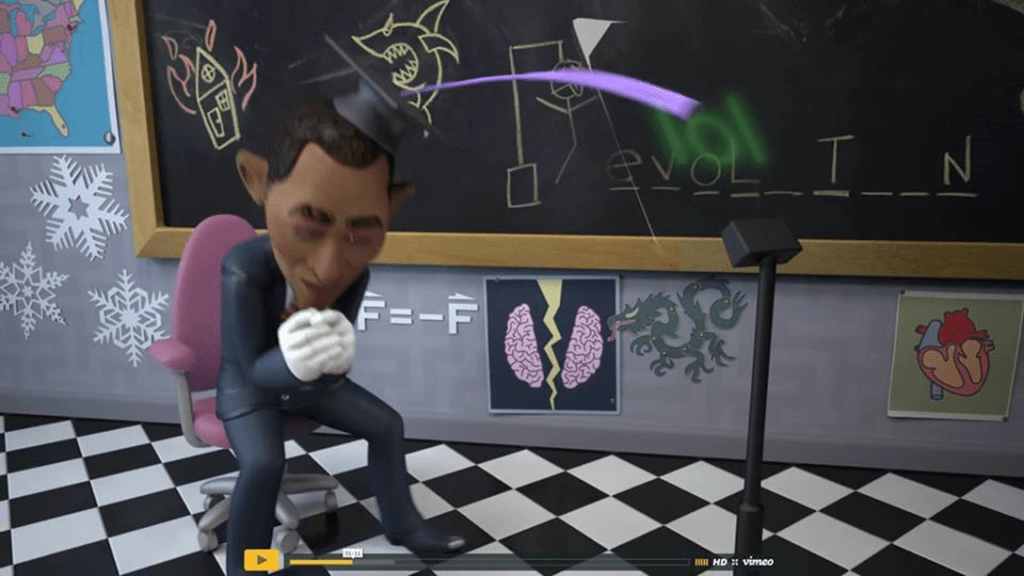
That same frame stacks additional “confirmation” cues. Above him is a shark, and the shark has a little-horn where its eye should be. A shark is the ultimate hunter of fish. Nimrod—the leader of the first rebellion of man against God—is called “a mighty hunter” (Genesis 10:8–9). Later interpretive tradition sometimes expands that “hunting” into oppression and renders it as “hunter of the sons of men.”
The timestamp itself—1:11—also reads like 101, but here the portal is “filled.” For a split second, the “1” (little horn) occupies the gateway—matching the frame’s central emphasis. And the Resurrection of Osiris, tied to 66, also points in the same direction, because Revelation describes the beast’s mortal wound being healed, to the astonishment of the world (Revelation 13:3; see also 13:12, 13:14). Taken together, this is why I read the symbolism as pointing to the moment Satan consummates with the mind of the man who becomes the antichrist.
This is where the symbols connect in a concrete way. In this symbolic system, 101 is not neutral scenery: it’s temple imagery, and temple imagery implies blood-sacrifice logic—the “price” of opening a spiritual gateway. That gateway then pairs with what you’ve already seen stacked beside it: 59 (identity) and 66 (rebirth/resurrection language). Read through Scripture’s lens, the “resurrection” emphasis points toward the beast’s mortal wound being healed—presented in this messaging as an awaited culmination by the global elite who craft and spread this symbolism.
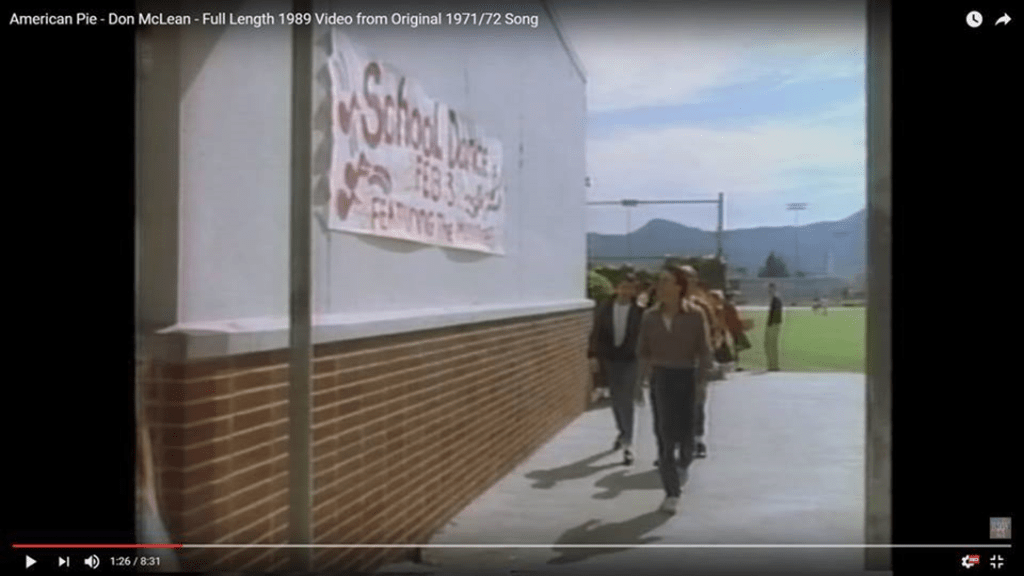
This sequence begins around 1:26 as the lyrics shift into direct questions about faith—whether trust is anchored in the Bible, or in another spirit dressed up as “music.”
Did you write the book of love
And do you have faith in God above
If the Bible tells you so?
Do you believe in rock and roll?
Can music save your mortal soul?
As students move in and out of the school, a banner on the building reads: “FEB 3 – FEAR ME.”

It’s easy to miss because it’s embedded in a school dance banner. Zoomed out, “FEAR ME” can look like the start of “Featuring …”—which is why I’m showing the context next.
From there, the lyrics move fully into the dance theme:
And can you teach me how to dance real slow?
Well, I know that you’re in love with him
‘Cause I saw you dancin’ in the gym
You both kicked off your shoes
Man, I dig those rhythm and blues
The lyrics and visuals subtly point to conflict. “Dance” is often used as a metaphor for conflict handled with delicacy and precision—a sword dance, a dance of words, a careful contest where one party is trying to pull another into his lead. In the video, two young men are competing for the attention of the same young lady. However, I believe the lyrics point to something personal: which “music,” which spirit, which faith will you follow? The banner’s message (“FEAR ME”) sits over that choice like a shadow, turning the “dance” into a spiritual pressure point: intimidation meant to steer people toward the easier path.
So why Feb 3? In this symbolic system, dates often function as number-tags. Feb 3 → 2/3 → 23 and 23 shows up frequently in Illuminati symbolism.
The meanings of 59, 101 and 66 are clear to me. With 23, I can only postulate. At the most basic level, the message reads like this: as you weigh which path you will take, you will be pressured toward the easy—or wrong—path. Most people miss the narrow way because they follow emotion, comfort, or social pressure.
Jesus framed that same choice:
“Enter by the narrow gate. For the gate is wide and the way is easy that leads to destruction, and those who enter by it are many.
For the gate is narrow and the way is hard that leads to life, and those who find it are few.” Matthew 7:13–14 (ESV)
My best working hypothesis for “23” is that it points to two threes—two interlocking triangles (the so-called star of David)—because Scripture itself uses star language when it describes rebellion and idolatry. Stephen quotes that language directly when confronting Israel’s pattern of turning from God just before he is martyred:
My best working hypothesis for “23” is that it points to two threes—two triangle that can be rendered as an image of two interlocking triangles or the star of Saturn. Stephen quotes that prophetic “star” language directly when confronting Israel’s repeated turning from God—just before he is martyred:
“You took up the tent of Moloch and the star of your god Rephan, the images that you made to worship; and I will send you into exile beyond Babylon.”
Acts 7:43 (ESV)
Stephen was quoting from Amos 5:26:
“You shall take up Sikkuth your king, and Kiyyun your star-god—your images that you made for yourselves.”

The banner is real (“FEB 3 – FEAR ME”), the timing lands inside a faith-testing stanza, and the scene frames a choice around the girl at the center of the dance. I may not have the full subcode of “23” pinned down—but the surface message is unmistakable: fear is being planted as the motive force right where the lyrics press the question of what (and who) you truly trust.
In the body of this article, I focused on the three numerical anchors I see in the emblem—322, 11/6, and a compact 1:59 structure. Here I’m adding a few non-numeric layers to give a fuller understanding of the emblem and its numbers.
On of the first things I notice is that the two thigh bones cannot be from the same body because of the way the “knee” nubs bend. Because they cross each other, they read as conflict—war.
In summary, the logo points to the coming of the antichrist system (the New World Order) through deception that culminates in war, and it supports the global elite belief in human ascension to the level of God.
The eyes are not symmetrical. A cloudy clockwise swirl begins on the forehead and feeds into the viewer-left eye. That eye is partly ringed by a hexagon-like swirl, and behind the socket I see a mouth.
On the viewer-left side of the skull, just left of that eye, is the silhouette of a face. This face matches Drako in Heliofant’s I, Pet Goat II. On Heliofant’s gallery page, Drako is described as:
“The Sorcerer, the unseen hand and spirit of madness seeking ever more control through trickery, lies, poisons, false-flag events, wars and mountains of beauracratic [sic] and legal framework to siphon off the energy of the inhabitants of the earth. He fears the light of day as he fears life itself, and operates in the shadows. His greatest power is his hold on the issuance of currency.”

This reinforces my understanding that when Satan consummates with the man that will become the antichrist, he will lose his right eye when he receives his mortal head wound, and will arise as the spokesperson of Satan. Zechariah 11 describes an antichrist figure as the “shepherd of the flock doomed to [be] slaughter[ed]” and the “worthless shepherd” and it also describes an injury he will sustain from conflict:
May the sword strike his arm and his right eye!
Let his arm be wholly withered, his right eye utterly blinded!”
(Zechariah 11:17, ESV)
A clear “human ascent” / New World Order message comes through if you read the emblem’s 322 and 11/6 as pointers into Genesis:
Then the Lord God said, “Behold, the man has become like one of us in knowing good and evil.”
(Genesis 3:22, ESV — excerpt)
And the Lord said, “Behold, they are one people, and they have all one language, and this is only the beginning of what they will do. And nothing that they propose to do will now be impossible for them.”
(Genesis 11:6, ESV)
It might also be a reference to Genesis 6:11, which led to the world’s destruction:
Now the earth was corrupt in God’s sight, and the earth was filled with violence.
(Genesis 6:11, ESV)
We already covered the meanings of 1:59 (the little horn and the beast/antichrist) and 11/6 (the Ring of Six / “resurrection” framework I discussed in Part 2). But 11/6 also echoes in a few other ways:
Some high-profile figures widely reported to have been members of Yale’s Skull and Bones society include George H. W. Bush, George W. Bush, John Kerry, William Howard Taft, and Prescott Bush.
Some treat 322 as a date-signature—March 22—a day near the spring equinox that has coincided with major events. A friend I learned from early on predicted the date of the Brussels airport bombing (March 22, 2016), and the Westminster Bridge attack also occurred on March 22, 2017.
I do believe dates can be signaled in this symbolism, but the layer is purposely deceptive and easy to misread. I was able to anticipate the dates of several events—such as the Orlando Pulse nightclub attack (June 12, 2016) and the Las Vegas mass shooting (October 1, 2017). I believe I, Pet Goat II (released 2012) foreshadows the Pulse date. Notice the numeric pattern: 6/12 can be read as 6 + (6+6) → 666, and 10/1 reads as 101. Other high-profile events land on similar number-structured dates, including: Trump’s Jerusalem announcement (December 6, 2017), the Trump–Kim Singapore summit (June 12, 2018), and Iran’s major missile attack on Israel (October 1, 2024).. Another Trump–Kim meeting fell on the 59th day of the year (February 28, 2019).
So I’m not date-setting here. I’m only noting that 322 is often treated as a date-signature, and that certain dates recur in ritual-style signaling. Even if the date layer is disputed, the emblem’s intent remains readable.
Tracing God’s Fingerprint in Genesis 46 and Numbers 7
In The Marriage Supper of the Lamb – Part 2 we saw that Scripture by itself, as “letter,” is dead; it is the Holy Spirit who makes the Word alive—for, “the letter kills, but the Spirit gives life” (2 Corinthians 3:6). Any study of the Bible that focuses only on the text as an academic object usually misses the depth of meaning God intended—especially in the Old Testament.
So can I “prove” my understandings are correct? Not in a mathematical way. The only real confirmation is if the same Holy Spirit bears witness in your heart. There is also a second safeguard: no true understanding of Scripture will contradict any other part of Scripture. If an interpretation requires us to ignore even a single verse, it is not from God. The understandings I present here are, to the best of my knowledge, in harmony with all of Scripture—and I welcome honest testing and challenge on that basis.
Quoting Moses, Jesus said, “Man shall not live by bread alone, but by every word that comes from the mouth of God.” To me, that means every word in Scripture matters.
Why are we told Peter caught exactly 153 fish in John 21:11? Why, in the middle of one of the longest and hardest-to-read genealogies in the Bible, does Nehemiah 9:11 speak of “a stone” being cast “into mighty waters,” while Exodus 14:21 says a strong east wind parted the sea?
These kinds of details began to stand out to me. A new texture—and, most of all, life—began to emerge, as if a new dimension opened above the black letters on a white page. Meaning began to “float” above the text in the illuminating golden light of the Lampstand.
What I call God’s “signature” in Scripture—patterns that authenticate the Bible as His Word in a way no human author could have orchestrated—is exactly this: illuminated meaning that seems to rise from the pages and brings a deep confidence and peace that it truly is God’s Word.
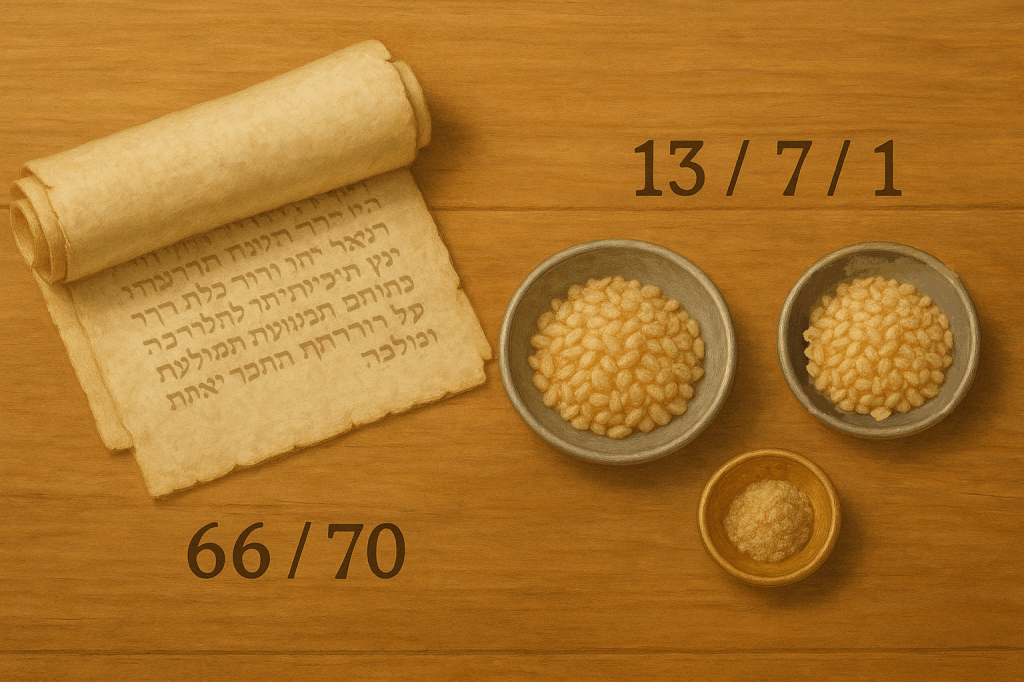
Genesis 46 records Jacob going down to Egypt with his family. The chapter carefully lists the descendants of Jacob who went to Egypt, and then gives us two counts:
Scholars debate how to reconcile these numbers. Most readers overlook them. To me, the 66/70 pattern looked deliberate, but I did not yet know what it meant. I simply kept it prayerfully tucked away in my heart.
Some time later, as I was planning another full read-through of Scripture, that unanswered question came back.
I am currently reading through the Bible for the ninth time. I don’t read from Genesis straight through to Revelation. Instead, I mix the order to see more cross-connections. In one of these cycles, I decided to split the book of Psalms into its five internal “books,” because Psalms is so long and is already clearly partitioned.
When I did that, I realized something simple but striking:
There was that 66/70 pattern.
When I saw that, Genesis 46 came back into my mind. I had been praying over the double count there, and now I saw a link:
My conclusion is not that “the Bible is 66/70” as a bare number. Rather: 66/70 is the number of the seed of the house of Israel, and Scripture is that seed.
Here it is important to remember who Israel is.
The “house of Israel” is therefore not just an ethnic label; it is the house of God’s people—those who belong to Him and walk by faith.
Scripture itself uses “seed” both in the physical (descendants) and spiritual sense (the Word):
So when I see Genesis 46 highlighting the seed of Israel as 66/70, and the canon of Scripture mirroring 66/70 depending on how we count Psalms, I see a quiet signature of God that confirms the Bible is the “seed” of the house of Israel—God’s house.
This brings us to Numbers 7, another place where, at first glance, the text is repetitive and easy to overlook—and yet another place where I believe God has left His signature authenticating the Bible.
Numbers 7 describes the dedication of the tabernacle. The twelve tribal chiefs bring their offerings. The offerings are identical, and the chapter repeats the full list verbatim, twelve times, once for each tribe. Many readers skim this section. Many commentators summarize it instead of reading it through.
As I prayed over this chapter, I sensed the Lord impress something on my heart:
“Do not skim this. Read every offering, all twelve times. It is this way for a reason. If you are faithful to read it this way, I will give you understanding.”
So I read each repetition of the offerings of the twelve tribes as if I were reading it for the first time.
The next day I started a long journey, on a train from Sumy, Ukraine to Moscow, with a nine-hour stop in Kharkov. As I lay in my cabin, I played back Numbers 7 in my mind, prayerfully considering the details I had read the day before. There were two offerings of grain and oil on silver platters of 130 and 70 shekels, and one offering of incense on a gold platter of 10 shekels.
What did the 13/7/1 mean? Why was there grain and oil on two of them but incense on the third? What did the silver and gold mean?
The more I contemplated it, the more three simple observations stood out:
Grain and oil match what we have already seen: the Word (grain) made alive by the Spirit (oil). Incense, in turn, is a picture of prayer received in heaven before God (as we see in Revelation 5:8, where we read of “golden bowls full of incense, which are the prayers of the saints” and in Revelation 8:3-5, where incense is offered with “the prayers of all the saints” and then thrown to the earth).
In The Marriage Supper of the Lamb – Part 2, we described grain—which grows above the earth—as symbolic of manna from heaven, and oil as a picture of the Holy Spirit who gives that Word life. So we can see the grain-and-oil dishes as representing the Word of God made alive by the Holy Spirit. Incense clearly pictures prayer.
Even the metals speak. Silver is pale like the moon; gold shines like the sun. The moon’s light is only a reflection of the sun’s light. Silver, then, can picture what is on earth, reflecting heaven; gold points directly to the source—heaven itself.
Seen this way:
This 13/7/1 pattern is not random. It appears elsewhere in Scripture in ways that cluster around sacrifice, fullness, and completion. One striking example is the Feast of Booths in Numbers 29, where:
Again we see a 13 / 7 / 1 shape around offerings and consecration.
In Numbers 7, the 130–70–10 shekel dishes form a 13/7/1 pattern and carry exactly the elements we have been tracing: grain and oil (Word and Spirit) on silver, and incense (prayer and worship) on gold. For me, this became another part of God’s “signature”: hidden inside a chapter most people skim, He quietly sketches the basic structure of His Word.
In the Old Testament, Israel is often functioning as thirteen tribes: Joseph is divided into Ephraim and Manasseh, and Levi is set apart in the center around the tabernacle while the other tribes encamp around them. In that light, the “13” can be seen as pointing to God’s Word and Spirit given to the genealogical tribes of Israel—the Old Testament.
In the New Testament, Jesus walks “among the seven golden lampstands,” and we are shown seven churches (Revelation 1–3). The “7” in the second silver dish fits this: the Word of God, made alive by the Spirit, given to the seven churches—the New Testament.
The “1” then points to a single, distinct book: Revelation itself—a book not simply written from earth looking up, but dictated to John in heaven, where the bowls of incense gather the prayers of the saints.
Even the gaps in the numbers—13 down to 7, and 7 down to 1—are 6 and 6, again hinting at the 66 pattern tied to the whole Bible’s sixty-six books.
There is another 13/7/1 pattern echoing this structure inside the New Testament itself:
I don’t claim these patterns as a mathematical proof, but I believe they are God’s quiet signature—ordering His Word with a consistency no human author could have engineered, and leaving hints of that order in places like Numbers 7 that most readers pass over quickly.
Taken together, Genesis 46’s 66/70 pattern for the seed of the house of Israel and Numbers 7’s 13/7/1 pattern for the dishes and offerings look to me like two sides of the same signature: the number and structure of the seed of the house of Israel, the Word of God. These are not proofs in a laboratory sense, but if we both have the Holy Spirit, He can confirm what is true and set aside what is not.
For those who are interested in how the Lord led me into this way of reading, I want to share a bit of my own story.
I read the Bible twice in my twenties, then on and off for the next two or three decades. In 2011 I became a digital nomad and have lived in many places since. I spent a lot of time in Ukraine—Sumy, Mykolaiv, Crimea, Luhansk, and also the western parts like Lviv and Kolomyia in the southwest. I understood the regional differences and the tensions keeping the nation divided.
When the Maidan protests began in 2013–2014, I followed the news closely. I watched what Western media and U.S. officials were saying, and compared it to what I experienced while living there. It became clear to me that the West was more interested in narratives that justified force than in truth that could lead to peace. I understood then where the U.S.’s meddling would lead.
I remembered Daniel 7, where the bear is told to “arise and devour much flesh.” I understood what I was watching in real time was part of what Daniel saw: the shifting of empires and the approach of a third world war. Russia is the bear, and Ukraine, one of the three ribs in the bear’s mouth.
In my twenties I attended a “charismatic Baptist” church. They taught what is often called the “five-fold ministry” from Ephesians 4:11—apostles, prophets, evangelists, shepherds (pastors), and teachers—as if these were institutional offices to be filled and managed.
The main Bible teacher (who bore the title “apostle”) had real insight—and I still believe much of his teaching came from a sincere place. But looking back, the system around him was driven by membership and money, not by the Holy Spirit. Emotion through music and institutional loyalty were often substituted for real spiritual connection, obedience, and truth.
When events in Ukraine escalated, I reconnected with that church, hoping to talk with one of their “prophets.” A true prophet will not simply echo the viewpoint of his own nation; he cares about truth before nationalism. As I listened, I realized their “prophets” were fully Americanized in their worldview. They did not see what was really happening. That was the moment when the veneer came off for me. I saw the institution for what it was.
More importantly, that was when I decided: I need to go back to Scripture myself.
At first, I opened a few well-known Bible commentaries on my screen beside the text. I would read a chapter of Scripture and then read what the commentators said about it.
Then, one day, quietly but clearly, I sensed the Holy Spirit speaking to my heart:
“Stop reading the commentaries. I will teach you.” After that, I began to see a bigger picture. My heavenly Father, through the Holy Spirit and the Word, wanted to have a conversation with me, but a third person was sitting at the table, constantly interrupting, rephrasing and injecting his comments into our conversation. Should a child not be able to understand his own father? Why should a stranger join in and try to talk for the father?
Jesus had already promised, “the Helper, the Holy Spirit, whom the Father will send in my name, he will teach you all things and bring to your remembrance all that I have said to you” (John 14:26). That does not mean we never learn from others, but it does mean that the same Spirit who inspired Scripture must be the One who makes it alive and clear in each of our hearts.
(In everything I write, I have no desire to replace that Teacher; my hope is that your love for the Word of God deepens, and that you find yourself more drawn to meet with God through it.)
From that point on I stopped going to commentaries for understanding. I now purposely use a physical ESV Bible with no commentary as my primary way of reading Scripture. If I don’t understand something, I pray for understanding. Sometimes it’s immediate; sometimes it takes days or longer; but whenever I have sought earnestly, I have received understanding.
Many “scholarly” approaches to the Bible lean heavily on schemes such as historical-critical analysis, source criticism and redaction criticism, and purely literary analysis, all wrapped in highly technical “biblical hermeneutics” that imply only trained experts can really understand the text.
The Bible, however, was given for the whole people of God—for anyone with an open, believing heart—not just for those with degrees and titles.
Those tools can sometimes provide useful background, but they are not the same as listening to the Author with an open heart. If we treat the Bible only as an object of academic study, we may become clever—and also blind.
And the final message is that God’s people need to return to the Word of God—undivided across denominations and continents—peeling back doctrines introduced over the ages by human interests, doctrines that separate us from real relationship and living knowledge of God the Father and Jesus the Son.
In Part 2: Sixes, Sevens, and the Two Witnesses, we will look at another layer in Numbers 7—the six-and-seven pattern in the animal offerings—and how it connects to God’s end-time work in His Church.
And in Part 3: Seven Lamps, One Bride, One King, we will show the completion of the number pattern, as it finishes in Numbers 8, and how it points to the completion of this age.
Madonna’s “American Pie”: The Simple Code
In Part 1, I argued that American Pie is not just a nostalgic song about the 1960s but a prophetic warning about the fall of America—Rome burning in modern clothes. Don McLean has now admitted that politics and music are flowing together in the song, and that the verses grow “more dire” until the end. I also introduced the “deleted verse” with its five-year marker and why I believe that timing could only have come from God.
Now we turn to Madonna’s version of American Pie.
On the surface, it is shorter and lighter. But, it functions as a kind of “primer” or simple code. It introduces key symbols—numbers like 1:01 and 1:59, colors like red and black, the “Rebels” cheerleaders, the “sacred store,” and the final flag—so that once you see them here, you can recognize the same pattern in more complex videos, especially in the video made for McLean’s version of the song.
This is a version of the video I reference in this article: https://www.youtube.com/watch?v=PRa9ulVPZYA. In earlier versions, some of the images were clearer, especially the frame at 1:59. In this version that frame has been slightly blurred, but it still shows enough that, if you slow the playback, you can see the shape. I kept an older copy of some of the images, so where the newer version has been softened I will use still images from the original.
In Part 1 I mentioned how all versions of the American Pie videos briefly disappeared from the internet after I contacted McLean’s agent; to me, this later “cleanup” of the 1:59 frame fits the same pattern of quiet sanitizing.
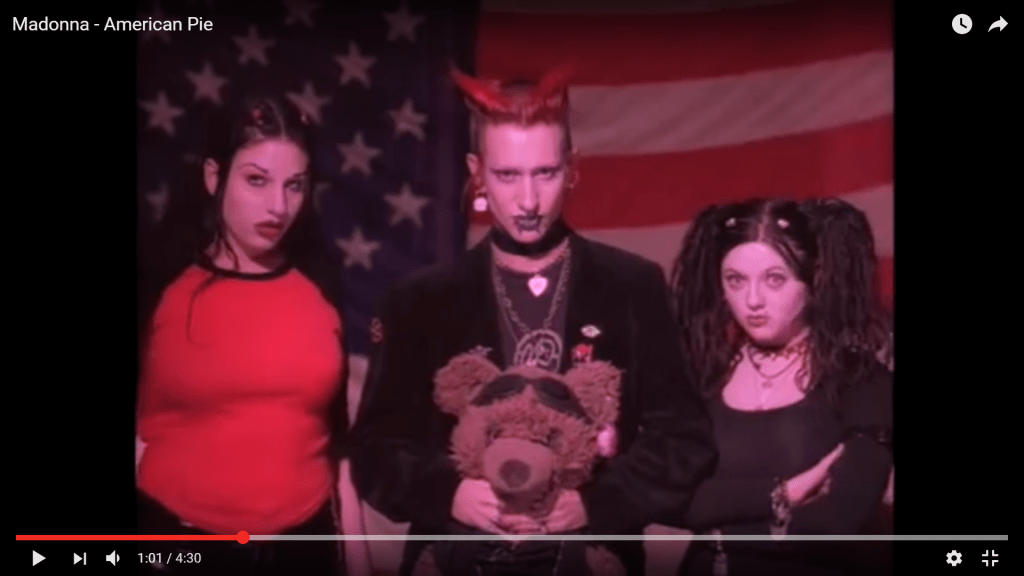
At 1:01 into Madonna’s video, we see a figure that looks like a Baphomet-style jester, framed between two women and holding a teddy bear. One woman is dressed in red, the other in black.
This is the “jester” figure McLean hinted at in his interviews—a real man in our time tied to politics, not just a generic clown. Here he is shown in a demonic form, like a Baphomet, with two spirit-like or coven-like women beside him. His mouth is painted black to illustrate that he will speak words from the kingdom of darkness. He stands slightly in front of the two women, to show that he is coming out. The teddy bear serves as a third spirit, completing the picture of three spirits around him and echoing Revelation 16:13: “And I saw, coming out of the mouth of the dragon and out of the mouth of the beast and out of the mouth of the false prophet, three unclean spirits like frogs.”
The timestamp 1:01 itself is important. “101” is symbolic of a gateway or portal between two temple pillars, and since first noticing it here I have found anti-Christ figures appearing at 1:01 in several other videos that use similar symbolism.
Red and black are not random fashion choices. They are the colors associated with the coming New World Order—the end-time beast system of Revelation. So in one frame we have:
This is the enemy quietly flagging: Here is the birth-gate for the anti-Christ system.

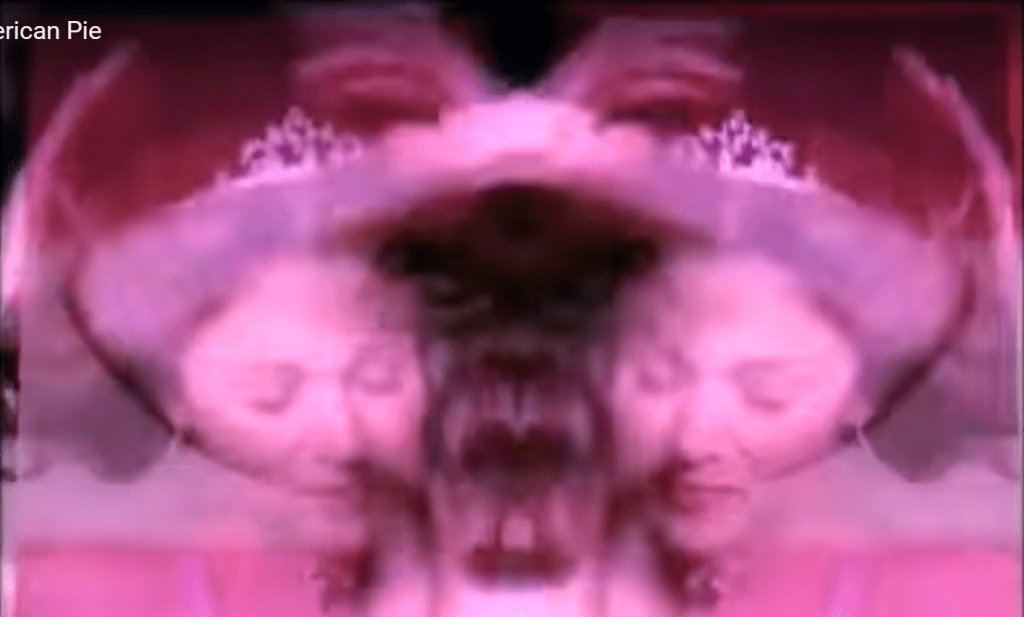
At 1:59 into the video, for a single frame in the original version, there is an image that looks like a demon emerging from between spread legs—like a birth. You need to slow the playback to 0.25x speed and tap play/pause around 1:58–1:59 to catch it. It forms and disappears very quickly, and in the newer version it’s not quite as well defined.
If the jester at 1:01 marks the gate, the demon at 1:59 marks the birth. This is not random art; it is a symbolic “delivery” of the antichrist into the world system.
The number 1:59 (or simply “159”) shows up repeatedly in Illuminati-style symbolism. Alongside 101, it is one of the timing marks I notice often. In brief, the “1” points to the “little horn” from Daniel’s visions (in Daniel 7 and 8), and “59” functions as a numeric marker for the antichrist—something we will unpack more fully in Part 3. Madonna’s video uses both:
Together, they form a pattern: a spiritual conception of the anti-Christ at 1:01 and his “birth” into the world system at 1:59.
In Part 3, we will look at how the McLean video and the Skull and Crossbones logo reinforce this same 1:59 pattern and confirm the 59 gematria behind it. If you learn these marks, you will start to notice them in many places. For example, on my Turkcell cellphone, *101# tells me my phone number and *159# gives my account balance. Coincidence? I think not.
A later echo of the same image is the She-Guardian statue that stood at Marble Arch in London from 2015 to 2016—a winged, dog-like “guardian” with its mouth open, 11 meters (36 feet) high.

To me, it looks like the same winged dog demon from 1:59, now grown and enthroned in a London gateway rather than still “in the womb” of the Madonna video. In my reading, the height itself is part of the message: 11 is a common Illuminati number, and 36 is a pyramid number whose sum from 1 to 36 equals 666—a shorthand for the beast.
Seen together, the jester at 1:01, the demon at 1:59, and She-Guardian sketch a sequence: conception, birth, and public maturity of the same beast system.
Madonna’s video gives one of the simplest number codes through the football team.
At 3:20, we see an American high school football team posed in front of the U.S. flag. The quarterback wearing number 7 leads, calling the plays.
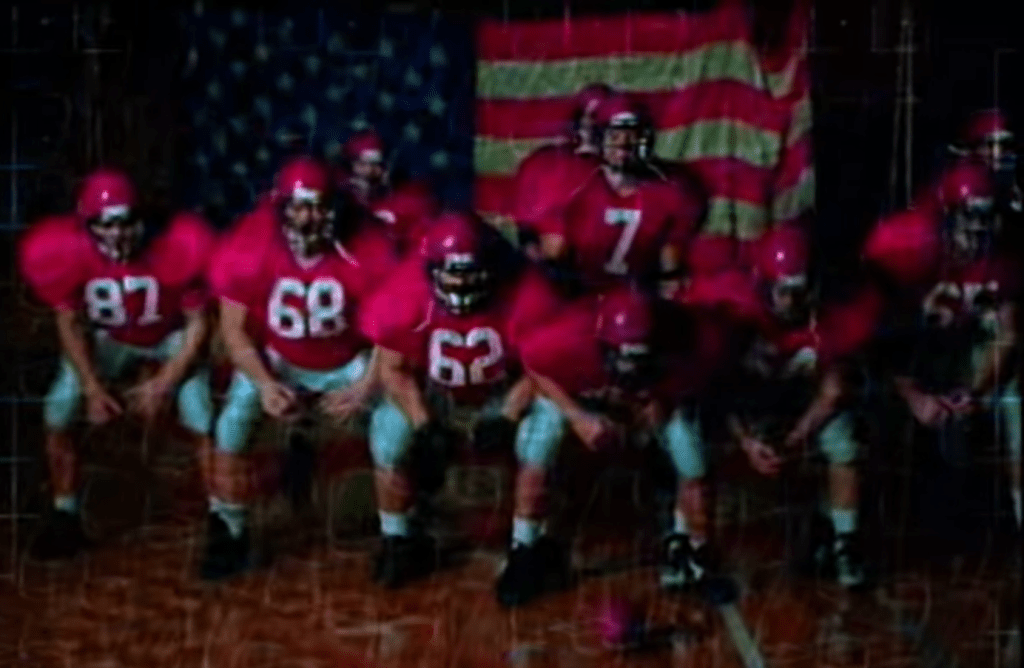
Later, at 3:56, the scene returns. This time another quarterback wearing a 6 steps forward to take his place. The 6 on his jersey is just slightly higher than the 7.

This is very common Illuminati symbolism. 7 is God’s number (our Creator rested on the 7th day), and 6 is the number of man (God created man on the 6th day). When you see 6 over 7, it pictures the doctrine, held by globalists and Satanists, of man’s ascension through knowledge to lift himself above God. I have pointed out the same pattern in my Marks & Spencer article, and you can see it in everyday products as well, such as these of Union Gas (Rockefeller) and Molson Canadian beer:
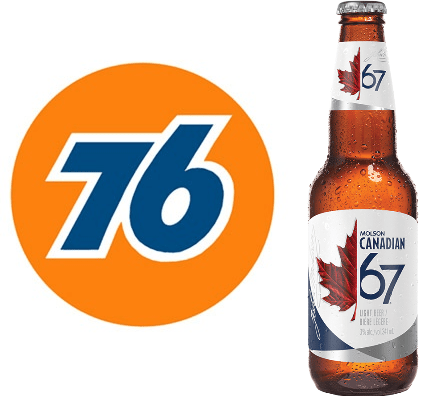
Notice how in each logo the “6” rides a little higher than the “7.” The same story: man rising above God, breaking His rule, “improving” on His design. In short, 6 v 7 represents the rebellion of man against God. In these end days, the rebellion will be led by a man commonly referred to as the antichrist:
The Bible describes him this way:
“Let no one deceive you in any way. For that day will not come, unless the rebellion comes first, and the man of lawlessness is revealed, the son of destruction, who opposes and exalts himself against every so-called god or object of worship, so that he takes his seat in the temple of God, proclaiming himself to be God.” (2 Thessalonians 2:3–4, ESV)
The number 42 is an extension of the 6 v 7 symbolism. 42—6 x 7—pictures man in an extended, head-on collision with God. It is not an accident that 42 keeps surfacing at moments of judgment. In 2 Kings 2, forty-two boys are judged by two bears after they mock God’s prophet. In Revelation, the beast is given authority to act for forty-two months. Even the structure of Daniel quietly echoes it: Daniel 7 shows war between four beasts (World War III), and Daniel 8 shows two beasts (World War II)—a 4-2 pattern that again ties 42 to end-time conflict.
The two bears in 2 Kings 2 are a picture of the two witnesses of Revelation 11, who will confront the nations when mankind is in open rebellion against God. So 6 v 7 is the rebellion of man versus God, and 42, as 6 × 7, is that rebellion reaching its appointed climax.
The center of The Hitchhiker’s Guide to the Galaxy is a supercomputer that announces “the ultimate question of life, the universe, and everything” is 42. Satan is speaking plainly: the meaning of life is 42—the clash between 6 and 7, man and God. Anyone who knows the Bible can see the symbol, but our culture has thrown away both Scripture and acknowledgement that Satan is the prince of this world (1 John 5:19). The message is clear; what is missing is the biblical lens to recognize what is being said.
Madonna’s football sequence uses exactly that language. First, 7 leads the team – our nation tries to let God lead. Then 6 steps up and visually overtakes him – then we rebel against God and try to lead ourselves. That is the backbone of the 6 vs 7 symbolism we will see again in the cheerleaders and in later videos, which shows us how it will end.
The cheerleaders appear several times, together telling a dark story of descension of the nation from our Patriotic beginning to beast-like servitude.
At 2:17, and earlier, they look like stereotypical American high school cheerleaders: energetic, smiling, and clearly framed by the American flag. Their uniforms say “Rebels.”
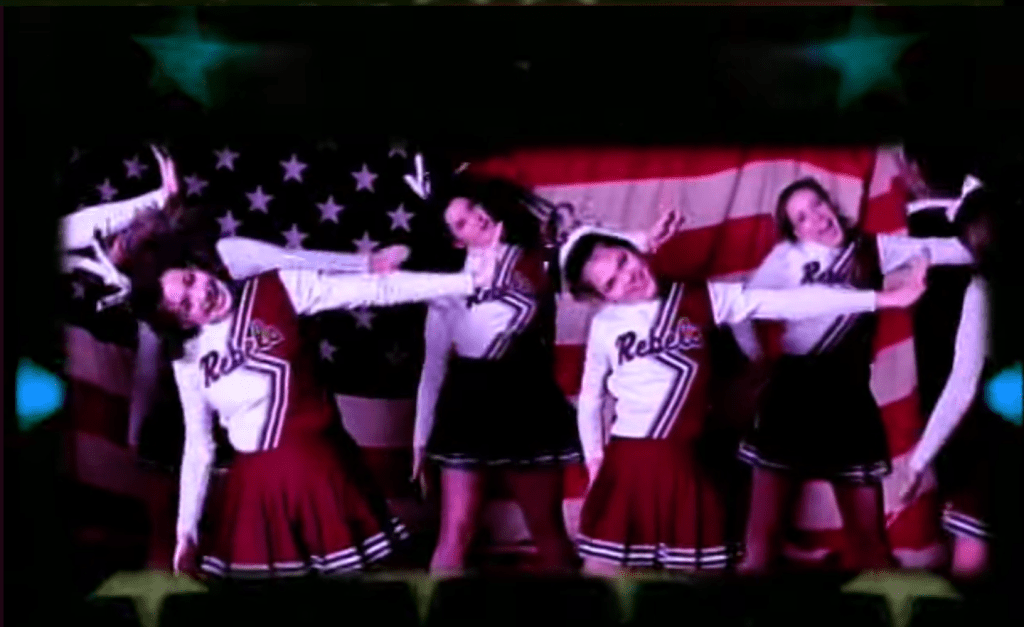
The “Rebels” uniforms stand for patriotic Americans who see themselves as willing to resist tyranny. This taps into the mythos of the American Revolution, the “land of the free and the home of the brave,” and slogans like “Live Free or Die”—the motto of my home state, New Hampshire. These are the people who think of themselves as on the side of freedom, rule of law, and the Constitution.
In some shots, including this one at 2:01 in the video, another layer appears. Over the dancing “Rebels” you can see strange, curved shapes superimposed on the image—almost like scattered puzzle pieces.

A friend who reviewed my earlier analysis pointed out that these shapes resemble the shape of the Antifa logo: which also uses red and black.

Here is how I read this: the rebel ethos that originally gave us constitutional freedoms has been hijacked. Instead of fighting for true liberty under God, people are channeled into street movements where “rebellion” is carefully controlled. The same spiritual power that once encouraged real resistance now directs rage against a contrived enemy, driving us toward a new global system.

Antifa demonstrations erupted in many countries, not just the U.S., and their colors are the same red and black we keep seeing linked to the beast system. The branding itself says “anti-fascist,” and we are trained to think the opposite of fascism is communism. That connects neatly with McLean’s lyric: “And while Lennon read a book on Marx.” The rebellion of the “Rebels” is being turned toward a Marxist-style street uprising, still under the authority of the same dark ruler.
The timestamp matters too. This frame sits at 2:01.
So the 2:01 mark quietly says: the rebellion of man against God (6 vs 7) has been fixed and set. The “Rebels” now march in a pattern that serves the same powers they think they are resisting.
Later (around 3:52), we see the same group again. This time a rainbow-like overlay runs down their uniforms and their raised arms block the word “Rebels.”
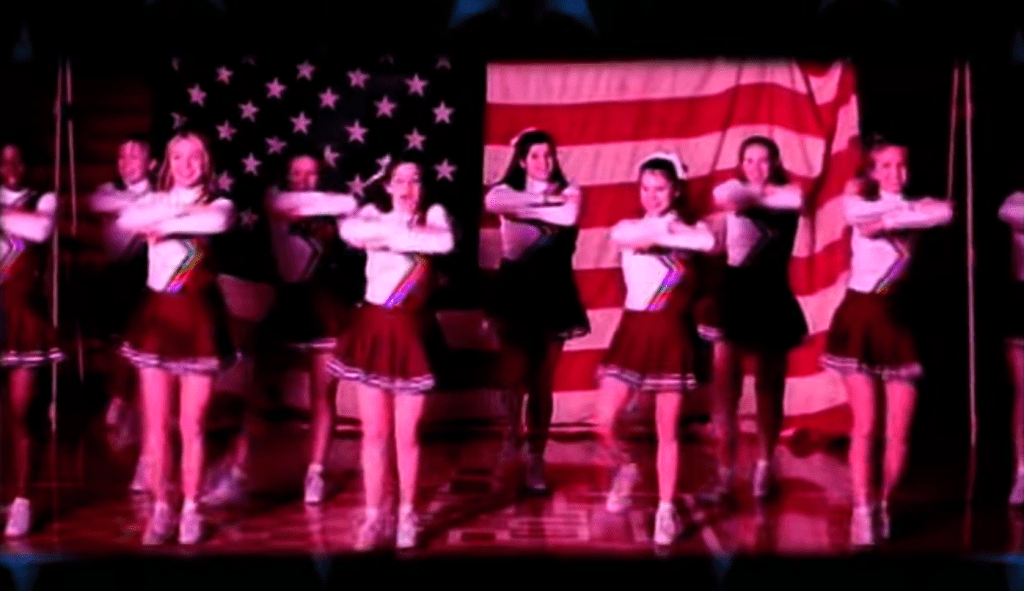
The message is simple: the same “rebels” have been repainted. The rainbow overlay and blocked text picture a shift:
The people who still think of themselves as freedom-loving rebels have been rebranded as cheerleaders for the New World Order.
At 3:19, the cheerleaders appear a a far more disturbing form.

They are no longer upright, smiling “Rebels.” Instead they are crouched on all fours, as if bowing or waiting for a command.
In the following cropped close-up, one girl in particular looks less like a person and more like a dog. Where her head should be, the distortion forms a dog-like shape with what looks like a red collar around the neck:

For me, this is not just a strange visual effect. It is a picture of what the beast system wants to do to human beings: take people who once stood upright as image-bearers of God and reduce them to obedient, animal-like subjects. The girls who began as bright, patriotic “Rebels” have been spiritually bent down and blurred into something beastly, depraved—no longer free, no longer truly human, but performing on command for the very system that has captured them.
Jesus warns that those who cling to rebellion and falsehood will end up outside the city of God:
“Outside are the dogs and sorcerers and the sexually immoral and murderers and idolaters, and everyone who loves and practices falsehood” (Revelation 22:15).
In other words, the depraved “dog” condition is the end of a road people choose, loving and practicing lies until those lies reshape them. They cooperate with the antichrist system’s lie, and in the end they lose their freedom, their dignity, and their souls. But that fate is not forced on anyone. In the McLean video we will see the contrasting path: what happens to those who refuse the beast and become faithful to Christ.
Putting the football and cheerleader imagery together, the simple code looks like this:
This is the end of the arc we have been tracing: from patriotic resistance, to controlled “rebellion,” to a New World Order rebrand, and finally to dehumanized, beast-like subservience—the real result of the 6-over-7 lie, where the promised ascent of man to “godhood” ends not in glory, but in the loss of both human dignity and freedom.
At 2:27 the lyrics say:
“Well, I went down to the sacred store
Where I’d heard the music years before…”
The “sacred store” is a gun shop: a man and woman standing in front of the U.S. flag with rifles and handguns laid out on the counter.
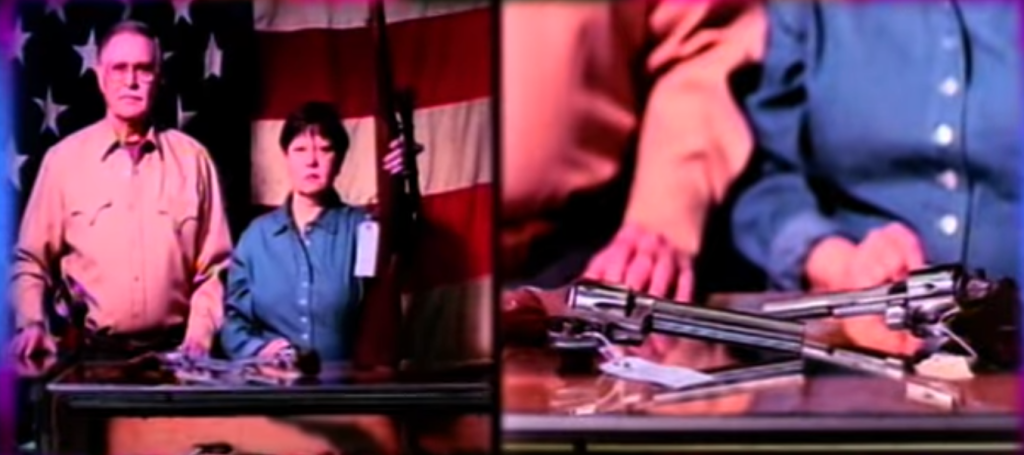
It symbolizes the right to bear arms—what many Americans treat as a sacred foundation of their freedom under the Second Amendment. They lyrics continue “but the man there said the music wouldn’t play”, hints that constitutional freedom has been silenced and Americans are no longer able to stand up to tyranny.
At 2:30, the scene shifts to a laundromat. A shirtless man leans on a row of industrial washers, with U.S. flags hanging in the background and there is a 13 under the circular door he is leaning on.
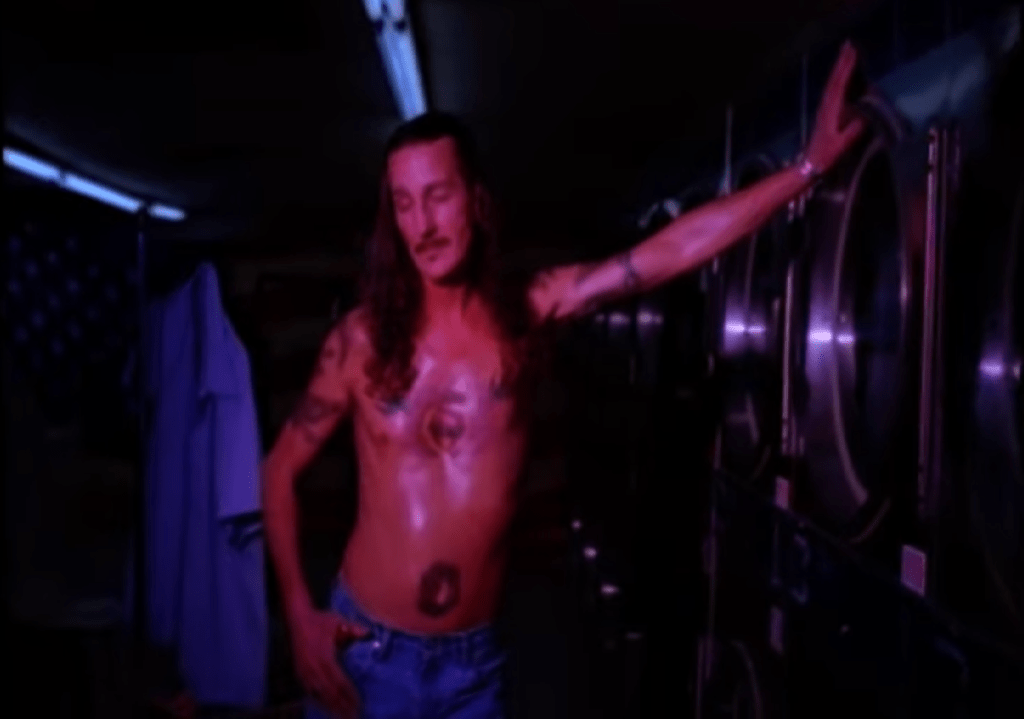
This scene was brighter in original version of the video, and these important details are easier to see:

They are still there in the current version, but are difficult to see because they have been darkened out.
This is not just any man. If you compare the faces carefully, he is the same jester figure from 1:01—now older and without the Baphomet costume. He stands in front of the discarded flags, physically blocking the way to them. Our access to liberty is cut off.
Americans have been “taken to the cleaners.”
There is a dark blotch around his navel—he has been born of spiritual darkness—the same anti-Christ / jester figure, now revealed without disguise.
Under the circular door he leans on is the number 13, making that door look like a spiritual gateway stamped with 13. It connects with what I call the “13th tribe,” Dan, which is missing from the list of tribes in Revelation 7. I explain this more fully in my Black Friday (by Steely Dan) article, but the short version is this: Jacob prophesies that “Dan shall be a serpent in the way, a horned serpent by the path, that bites the horse’s heels so that his rider falls backward” (Genesis 49:17). Revelation 17 shows the same pattern when the beast turns on the harlot who rides it and throws her off. The serpent tribe brings down the rider.
Reinforcing this view, he has several tattoos; one over his heart looks like a coiled or curved figure, suggestive of a serpent over the heart—the horned serpent of Dan, not a shepherd’s heart.
Furthermore, when a ruler takes off shirt, it symbolically means he intends to stay in power or come back to power by force. Both Putin and the man that has declared himself to be the antichrist (who we will cover in different posts) have taken off his shirt to pose for a photo opt for public consumption. When the man that has declared himself the antichrist revealed this image, he referred to Putin’s similar photo opt to point viewers to the meaning.
So in this laundromat scene, the jester:
Earlier in the video, at about 2:16, we are shown a different kind of “navel sign.” A young woman lifts her shirt to reveal her belly. Around her navel, in a circle, are the words “I love you.” She stands between two other people, echoing the three-figure framing at 1:01.

Again, the focus is on the navel—a place of birth and connection—another human “portal” between two “pillars.” In my understanding, she represents Lady Liberty / America. Where the jester’s navel is a dark stain in the laundromat, hers is ringed with “I love you.” America is being pictured as loving the very spiritual darkness that is about to destroy her.
Taken together, these scenes say a lot in a very short span of time:
The message, as I read it, is blunt: Americans have been taken to the cleaners. The old freedoms are quietly being removed, the gate to true liberty is closing, and a serpent-hearted ruler from the line of rebellion stands at the door—while the nation itself says “I love you” to the darkness that is leading her out of the sacred store and into judgment.
At 2:51, when Madonna sings “the church bells all were broken,” she does it with a triumphant, joyful tone. The scene is upbeat, arms raised, flag behind her.

When Don McLean sings the same line in his own performances, his tone is mournful. In at least one early performance you can see tears in his eyes as he sings; the whole moment feels like grief, not victory.
In Madonna’s version, “…the church bells all were broken, the three men I admire most, Father, Son and Holy Ghost, took the last train for the coast the day the music died” lands like an accomplished goal—the end of Christianity’s influence in America, celebrated on stage.
In McLean’s, it sounds like a funeral tolling. That contrast matters. It marks the difference between someone celebrating the new order and someone who, at least at the time of writing, felt the weight of what was being shown to him.
Madonna recorded more than one video for American Pie. In one version, the final scene includes an explosion and a bright flash of light.

It is hard to pin down a serpent because it keeps slithering away from the truth. This video has done the same thing. Years ago, after the flash faded, there was one extra beat where the American flag was replaced for a split second by another image. That beat is now gone.

The replacement image has a “101” structure. The central “0” is shaped so that it appears to have six sides on the outside and six sides on the inside—a hidden “66” associated with the “0.” You can see that in the screen shot of the earlier version the runtime was about a second longer (4:36, 4:35 of the current version), which fits with this final frame being removed.
If you compare the length of the video, to the video at the URL now, you will see in the video used to be one second longer, evidence that this scene was cut out.
Here again we see the 101 gate with a “66” hidden inside it. Sixty-six is 11 × 6 and is commonly used in Illuminati symbolism to represent rebellion or a change of government. D-Day was on June 6 (6/6), and in Star Wars, Order 66 causes the clones to change allegiance and destroy the guardians of the old Republic, the Jedi. It also shows up in the Gotthard Tunnel opening ceremony and is a symbol of the “Ring of Six” ritual—honoring six Egyptian gods, the parting of the astral veil, and the resurrection of Osiris. I plan to cover the Gotthard Tunnel ceremony in a future post.
So this closing sequence shows the U.S. flag flashing out and a 101/66 gateway flashing in: the old nation taken down, a beast-system government taking its place, and the anti-Christ rising from what Scripture describes as a mortal head wound:
And I saw one of his heads as it were wounded to death; and his deadly wound was healed: and all the world wondered after the beast. (Revelation 13:3)
I am convinced that healed wound is the moment of consummation of a man with the spirit of Satan—the point where the man finally becomes the antichrist in full.
Madonna’s American Pie is shorter than the original and lacks much of McLean’s lyrical complexity. But symbolically, it is not simple at all. It introduces, in plain sight:
If Part 1 laid the foundation by listening to what Don McLean has now admitted and by looking at the deleted verse, Part 2 gives us the basic “alphabet” of the symbolism: numbers (101, 159, 6 vs 7, 13, 66), colors (red, black, rainbow), roles (jester, rebels, gatekeeper), and key images (birth, portals, flags, beasts).
In Part 3, we will return to McLean’s own American Pie video and walk through it in detail—scene by scene—to decode the core Illuminati numbering behind it and to see how the same code appears there: the rise of a particular jester figure, a manipulated civil conflict, and the crushing of those who will not bow to the new order. Part 4 will then gather those decoded symbols into a plain narrative of what they say about America’s future.
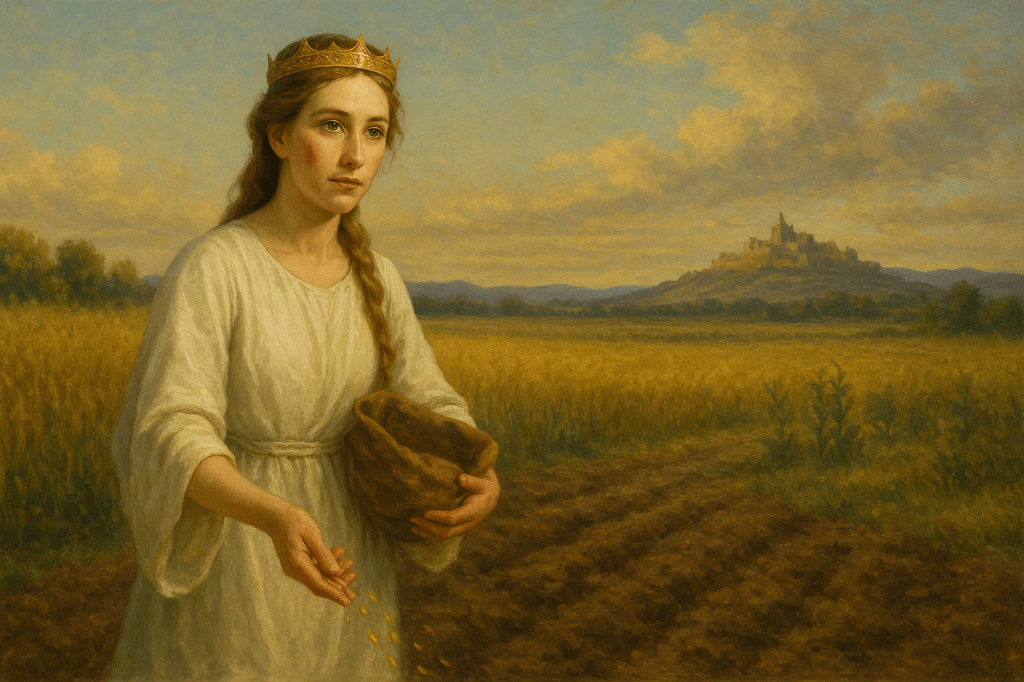
Bearing Offspring: The Righteous Deeds of the Bride
In Part 1, we looked at the marriage supper as a present reality: Jesus feeding us with His flesh, the pure Word of God, and calling us to gather that heavenly manna every day.
In Part 2, we focused on the cup — drinking His blood — receiving the Holy Spirit so that the Word becomes alive inside us. Without the Spirit, even the most accurate Bible reading remains dry and lifeless. With the Holy Spirit, the same words become living bread and living wine.
In this Part 3, we look at what that living Word and living Spirit are meant to produce: offspring for the Bridegroom. The Bride is not only invited to eat and drink; she is called to bear fruit, to bring forth spiritual children before the consummation of the marriage in the next age.
Scripture gives us a clear picture of a virgin, betrothed but not yet married, who nonetheless bears the promised Son:
“Behold, the virgin shall conceive and bear a son,
and shall call his name Immanuel.”
– Isaiah 7:14; Matthew 1:23
Mary is still a virgin, still only betrothed to Joseph when she conceives by the Holy Spirit. She is not yet in the fully consummated marriage, yet she already bears the Offspring of promise.
This is a pattern for the Bride of Christ.
We see the same pattern already hinted at in the test of the unfaithful woman (Numbers 5:11–31), which we looked at in Part 2. If she is found faithful, she does not merely survive — she bears her husband offspring. Faithfulness in the testing leads to fruitfulness.
In the same way, the faithful Bride of Christ is not only preserved; she is made fruitful. She bears Him children — not physical children, but spiritual offspring: lives brought to Him through His living Word and Spirit working in and through her.
The jealousy of God for His Bride appears throughout Scripture. On the road back to Egypt, after Moses has delayed circumcising his son as God had commanded, the Lord meets Moses in judgment. It is a strange and sobering scene:
24 At a lodging place on the way the Lord met him and sought to put him to death. 25 Then Zipporah took a flint and cut off her son’s foreskin and touched Moses’ feet with it and said, “Surely you are a bridegroom of blood to me!” 26 So he let him alone. It was then that she said, “A bridegroom of blood,” because of the circumcision.
– Exodus 4:24–26
The Lord is confronting Moses, because the covenant sign of blood has been neglected. Circumcision belongs to God; Zipporah’s act of obedience and the shedding of blood turn away death.
Who commanded circumcision — Moses or God? It is God who requires it. Circumcision is a sign in the flesh that belongs to Him. Prophetically, it points to the circumcision of the heart, a heart opened to God, separated for Him, willing to be changed.
Jesus is the true Bridegroom of blood:
This is not about us making ourselves perfect. It is about not hiding from His claim on us, not resisting His jealous love. We bring Him a washed, honest heart; He does the deep changing and cleansing over time.
After the fall, God speaks to the woman and to the man:
To the woman he said,
“I will surely multiply your pain in childbearing;
in pain you shall bring forth children.
Your desire shall be contrary to your husband,
but he shall rule over you.”
– Genesis 3:16
There is a natural meaning here, but there is also a prophetic picture:
We have a nature that is contrary to our Husband’s will, but we are called to come into obedience to Him. The Bride will bring forth children, but not without pain, struggle, and conflict with her own nature.
Then to Adam He said,
“Because you have listened to the voice of your wife,
and have eaten from the tree about which I commanded you, saying,
‘You shall not eat from it’;
Cursed is the ground because of you;
In toil you will eat of it
All the days of your life.
18 “Both thorns and thistles it shall grow for you;
And you will eat the plants of the field;
19 By the sweat of your face
You will eat bread…”
– Genesis 3:17–19a
The ground, “cursed” and full of thorns and thistles, is a picture of the soil of human hearts. In toil we bring the Word of God to this ground so that it may bear fruit. The thorns are the cares, worries, and deceitfulness that choke the Word. The thistles are false teachings and worthless ideas that compete with it.
Jesus makes this picture explicit in the parable of the sower (Luke 8:4–11). The seed is the Word of God. Different kinds of soil receive it differently. The harvest depends not just on sowing, but on the condition of the heart.
So:
Even the garments of the priests picture this.
“They shall have linen turbans on their heads, and linen undergarments around their waists. They shall not bind themselves with anything that causes sweat.”
– Ezekiel 44:18
In the inner courts they were not to wear anything that caused sweat. Prophetic picture:
For now, we sweat and labor to bring the harvest of souls, the offspring of Christ.
Paul pulls the picture together in Ephesians 5, where he speaks of husbands and wives and then says plainly that he is really speaking of Christ and the Church:
Wives, be subject to your own husbands, as to the Lord. 23 For the husband is the head of the wife, as Christ also is the head of the church, He Himself being the Savior of the body. 24 But as the church is subject to Christ, so also the wives ought to be to their husbands in everything.
25 Husbands, love your wives, just as Christ also loved the church and gave Himself up for her, 26 so that He might sanctify her, having cleansed her by the washing of water with the word, 27 that He might present to Himself the church in all her glory, having no spot or wrinkle or any such thing; but that she would be holy and blameless. …
31 For this reason a man shall leave his father and mother and shall be joined to his wife, and the two shall become one flesh. 32 This mystery is great; but I am speaking with reference to Christ and the church.
– Ephesians 5:22–27, 31–32
Jesus is actively preparing the Bride:
That consummation is not mainly about scenery or a change of location; it is about God giving us a truly new, perfect heart — the “white stone” with a new name (Revelation 2:17), His own nature written within. Only with hearts like His can paradise truly be paradise. With all the knowledge and glory of the age to come, if our hearts were still crooked we would only build new towers of Babel; with perfect hearts, love for God and for one another finally becomes our nature instead of a struggle.
Revelation gives us the same picture from heaven’s perspective:
“Let us rejoice and exult
and give him the glory,
for the marriage of the Lamb has come,
and his Bride has made herself ready;
8 it was granted her to clothe herself
with fine linen, bright and pure”—
for the fine linen is the righteous deeds of the saints.
– Revelation 19:7–8
Notice the tension:
These deeds are not the Bride trying to earn love. They are the fruit of a heart that has been:
Those deeds are part of her wedding garment.
Revelation also says:
“Blessed are those who wash their robes, so that they may have the right to the tree of life…”
– Revelation 22:14
The washing is now. The tree of life and the full access belong to the next age. The marriage supper prepares the Bride’s garments; the actual marriage is when she stands before Him fully clothed in what His grace has produced in her.
Jesus sums up the Bride’s commission in what we often call the Great Commission:
“Go therefore and make disciples of all nations, baptizing them in the name of the Father and of the Son and of the Holy Spirit, teaching them to observe all that I have commanded you…”
– Matthew 28:19–20
This is not a command to run religious programs; it is a call to live as His sons and daughters, truly fruitful:
When we:
Like a good tree that naturally bears good fruit, a heart filled with His Word and Spirit naturally overflows. Others are touched, awakened, drawn, and discipled. Christ’s own life in us begins to show itself. His life in us does not end in us; it multiplies.
The faithful Bride does not only “pass the test”; she becomes fruitful. She brings the Bridegroom offspring by sowing the living Word in the power of the Holy Spirit.
There is a cost to this fruitfulness. The church was built on the blood of martyrs, and Scripture says, “Precious in the sight of the Lord is the death of his saints” (Psalm 116:15). Jesus calls a Bride who does not “love [her] life even unto death” (Revelation 12:11). The key is not heroic willpower, but love that begins to outweigh fear: love for Him, and love for others who will otherwise face eternal loss. A faithful wife cares more about what her husband thinks than the opinion of the crowd; in the same way, the faithful Bride of Christ cares more about honoring Him and rescuing souls than about her own comfort or reputation. From that kind of heart, boldness can rise when circumstances demand it.
It is important to keep the order clear:
We are not trying to earn the marriage. We are responding to His love and His calling:
The fruit — the deeds, the offspring — is the result of His life in us.
So where does this leave us now, in very practical terms?
To live as the Betrothed Bride means:
The Betrothed—the virgin who bears offspring before the consummation—has made herself ready with righteous deeds here on earth. Those deeds flow from a Word-filled, Spirit-filled heart that brings forth spiritual children for the Bridegroom.
The veil into the Holy of Holies, the full unveiling of the marriage itself, belongs to the next age. For now, we remain in the outer sanctuary of this present age, being washed with the water of the Word and filled with the Spirit (Ephesians 5:26; 5:18). If we will stay at the table and in the field—Word, Spirit, and obedient deeds together—He will make us ready:
On that day He will give each overcomer “a white stone, with a new name written on the stone that no one knows except the one who receives it” (Revelation 2:17)—a picture of a new, perfect nature that does not erase the unique identity He gave us, but fulfills it.
Then in the next age, the marriage itself is revealed and God gives His Bride that new, perfect heart that makes true paradise possible for all eternity.
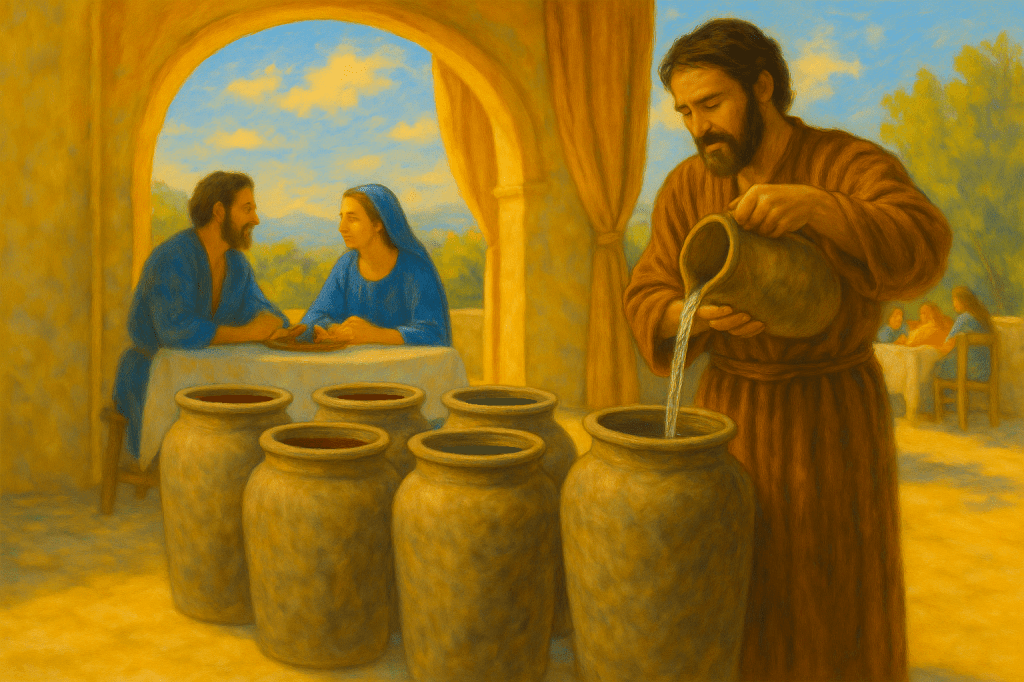
Drinking the Cup: Receiving the Holy Spirit
In Part 1, we looked at the marriage supper as a present reality: Jesus Christ feeding us with His own flesh, the pure Word of God, and calling us to gather that heavenly manna every day. In John 6 He says, “Truly, truly, I say to you, unless you eat the flesh of the Son of Man and drink his blood, you have no life in you.” In Part 1 we focused mainly on His flesh; in this Part we will focus mainly on His blood.
If eating His flesh is taking in the Word, then drinking His blood is receiving the Holy Spirit so that the Word becomes alive inside us. Without the Spirit, even the most accurate Bible reading remains dry and lifeless. With the Holy Spirit, the same words become living bread and living wine.
This is not a side topic. Learning to receive and walk with the Holy Spirit is central to loving God with all our heart, soul, mind and strength. At the marriage supper of the Lamb, we do not read as scholars trying to craft a sermon, but as a Bride sitting with her Bridegroom—opening the Bible and our heart together, prayerfully listening, responding, and seeking to understand His heart behind the words. Listening to our Father—really listening, in this two-way conversation of Word and prayer—is an act of love and respect.
In this article we will look at how Scripture itself ties together three things:
The Bible is very clear that there is a way to handle Scripture that brings death, and a way that brings life.
For the letter kills, but the Spirit gives life.
– 2 Corinthians 3:6
For the life of every creature is its blood.
– Leviticus 17:14
The Word of God, taken only as “letter,” can kill—not because there is anything wrong with the Word, but because our heart and our approach are wrong. The same Word, taken with a washed heart and a right spirit, becomes life when joined with the Spirit of God. Scripture links “life” with the blood; the life is in the blood. Spirit and life go together.
Create in me a clean heart, O God,
and renew a right spirit within me.
– Psalm 51:10
David is not claiming that he already has a clean heart. He is crying out for something only God can create. In this age, our part is to come before God with a washed heart—being honest about our struggles and sins, asking (or at least allowing) Him to change us, and then letting Him fill it with His Word and His Spirit—while we wait for the day He gives us a truly new, perfectly clean heart at the consummation—the marriage that comes after the supper.
So when Jesus speaks about drinking His blood, He is not inviting us into some mystical ritual for its own sake. He is calling us to receive the Holy Spirit, who makes the written Word alive in us. The Word of God does not come alive in us if we try to understand it based only on our own intellect. We must have the Holy Spirit. This is what Jesus meant by drinking His blood.
John tells us that Jesus began His public signs at a wedding:
On the third day there was a wedding at Cana in Galilee, and the mother of Jesus was there. 2 Jesus also was invited to the wedding with his disciples. 3 When the wine ran out, the mother of Jesus said to him, “They have no wine.” 4 And Jesus said to her, “Woman, what does this have to do with me? My hour has not yet come.” 5 His mother said to the servants, “Do whatever he tells you.”
6 Now there were six stone water jars there for the Jewish rites of purification, each holding twenty or thirty gallons. 7 Jesus said to the servants, “Fill the jars with water.” And they filled them up to the brim. 8 And he said to them, “Now draw some out and take it to the master of the feast.” So they took it. 9 When the master of the feast tasted the water now become wine, and did not know where it came from (though the servants who had drawn the water knew), the master of the feast called the bridegroom 10 and said to him, “Everyone serves the good wine first, and when people have drunk freely, then the poor wine. But you have kept the good wine until now.” 11 This, the first of his signs, Jesus did at Cana in Galilee, and manifested his glory. And his disciples believed in him.
– John 2:1–11
There is a simple, prophetic picture here:
Luke 5:36–38 uses similar imagery when Jesus compares our hearts to wineskins that must hold new wine. The pattern is consistent: we bring a soft, yielded, washed heart; He fills and begins to transform us by His Spirit.
The marriage supper of the Lamb is this very work: His Word, made alive by the Holy Spirit inside hearts that we wash and open to Him. In this way, the marriage supper is the true food that prepares us for the actual marriage consummation, when we will receive a truly new and perfect heart — His perfect nature — which is the necessary foundation for living forever in the paradise of God.
In Exodus, God gives detailed instructions for the tent of meeting. These details are not just ancient ritual; they reveal how God invites us into fellowship with Himself.
The tent has two chambers: an outer sanctuary, which is holy, and an inner sanctuary, which is the Holy of Holies. Its walls are scarlet, blue, and purple like the walls of a heart, and its covering is of tanned (dyed red) goat skins (Exodus 26), which are soft. Its design represents a heart, the heart of God.
To enter, one must be washed and then sprinkled with the blood of the sacrifice (Exodus 29). Inside the outer sanctuary is:
Paul helps us see what this means for us:
For a tent was prepared, the first section, in which were the lampstand and the table and the bread of the Presence. It is called the Holy Place. 3 Behind the second curtain was a second section called the Most Holy Place…
8 By this the Holy Spirit indicates that the way into the [Most Holy Place] is not yet opened as long as the first section is still standing 9 (which is symbolic for the present age).
– Hebrews 9
The outer sanctuary, with table and lampstand, is symbolic for the present age. It is where God meets His people now.
Thus, after washing, putting on clean clothes, and being sprinkled by the blood of Jesus—remembering what He did for us and that we are His bondservants—we are also to enter into this Holy Place to meet with God. There He meets with us and reveals His heart through the Word of God, illuminated by the Holy Spirit.
In so doing, the Word of God (the flesh of Jesus) is illuminated and comes alive in us by the golden light of the Lampstand (the Holy Spirit, the “blood” of Jesus). Here, in this very real daily “tent of meeting,” formed as a picture of God’s heart, is where the marriage supper happens in very practical terms.
All through the Old Testament, God pairs grain (bread) with oil. In a stalk of wheat or barley, the head of grain forms at the very top, holding its seed high above the earth—a simple picture of bread that “comes down” from above, like the manna from heaven, while the oil poured over it points to the Holy Spirit who makes that Word alive.
Grain offerings are always accompanied by oil (for example, in Leviticus 2; 6, Numbers 7 and Malachi 1–2). Word and Spirit are not meant to be separated.
There is a sobering counter-picture in the test of the unfaithful woman by the jealous Husband (Numbers 5:11–31). In that test, the grain offering has no oil. Both the unfaithful and the faithful woman experience pain in the testing; the unfaithful woman withers, but the faithful woman bears her husband many children. This is a cast and shadow of how Jesus, the jealous Husband, tests His Bride. If we are unfaithful and do not have the Holy Spirit in us, the Word of God brings death. But if we do have the Holy Spirit, that same Word brings new life—spiritual offspring—consistent with the commission of the Bride of Christ, the Church (Matthew 28:18–20), to bring Him children by sowing the Word made alive through understanding given by the Holy Spirit.
The same pattern appears in the parable of the ten virgins (Matthew 25:1–13). All ten have lamps. All ten are waiting. The difference is oil. The virgins who were not ready thought the Bridegroom would come for them early in the night, but He came for them late in the night, and they ran out of oil. They did not have the Holy Spirit. Jesus says of them: “Truly, I say to you, I do not know you.”
Most English translations of this parable indicate those that were ready went with Him to the “marriage supper.” However, the original text in Matthew 25:10 uses only γάμος (“wedding” / “marriage”), not δεῖπνον (“supper”), highlighting the difference between the marriage and the marriage feast.
By contrast, Revelation 19:7–9 speaks of both:
“the marriage of the Lamb has come” (ὁ γάμος τοῦ ἀρνίου) and those who are invited “to the marriage supper of the Lamb” (εἰς τὸ δεῖπνον τοῦ γάμου τοῦ ἀρνίου).
This makes a real distinction between the marriage supper and the marriage itself. The supper is preparation time in this age; the marriage is union in the next age.
Personal note: After I had come to believe that the marriage supper is here and now on earth, I read Matthew 25 (ESV) one night before going to sleep and felt deeply disturbed, because it did not fit what I had thought I understood. I tossed and turned for hours until I finally got up, opened an interlinear, and saw that the text said simply “wedding,” not “wedding supper.” It was a relief because it confirmed the pattern I felt the Holy Spirit had impressed upon me—but it continues to bother me because this single added word in translation can bend our understanding and sow confusion on such an important topic.
Jesus later calls Himself “the bright morning star” (Revelation 22:16). Morning comes after night. Isaiah 21:12 says that “morning comes, but also the night.” The foolish virgins expected an early rescue—before the night really gets started. The wise were prepared and endured through the night with oil in their lamps.
So what does faithfulness look like now? It is not enough to say, “I believe.” Faithfulness means:
The Betrothed—the virgin who bears offspring before the consummation (Isaiah 66:7–9)—has made herself ready with righteous deeds here on earth. As Revelation says, “Blessed are those who wash their robes, so that they may have the right to the tree of life” (22:14), and “for the fine linen is the righteous deeds of the saints” (19:8). Those deeds flow from a Word-filled, Spirit-filled heart that brings forth spiritual children for the Bridegroom.
Jesus gives a strange picture in Luke 17:6:
And the Lord said, “If you had faith like a grain of mustard seed, you could say to this mulberry tree, ‘Be uprooted and planted in the sea,’ and it would obey you.”
When you read about the faith of the mustard seed, how do you react? Do you think, “I just don’t understand”, and move on? Do you assume that “faith of a mustard seed” is something nobody really has? Or do you stop, ponder, and ask your Heavenly Father for understanding? Are you really “eating” the Word of God and do you believe that the Holy Spirit can teach you?
This is where the Holy Spirit makes the difference between “letter that kills” and “Spirit that gives life.”
For most of our lives, we can read verses like this for years and quietly tolerate a gap between what Jesus says and what we experience. We may treat His words as exaggerations or riddles we are not meant to understand. But His words are true. The gap is not in Him; it is in us.
The point here is not to become obsessed with throwing trees into seas. The point is: will we bring the hard verses to God and ask Him to teach us? Will we hold His words in our heart and wait on the Spirit until He gives understanding?
That is part of drinking the cup. That is what it means to treat the words of Jesus as living, not as religious phrases we skim over.
I encourage you to seek the Lord yourself on this verse in prayer and in the Scriptures; and if you stay with me, in a later article on the Gog and Magog prophecies in Ezekiel and Revelation I will share my understanding of this “mulberry tree” being uprooted and thrown into the sea that I believe He has given me. Food for thought: What kind of fruit is the fruit of a mulberry tree? What “sea” is Jesus referring to? Why would God want a mulberry tree thrown into the sea? I once bought a bottle of mulberry wine and spent several days praying and asking God questions like these before the meaning became clear to me.
In practical terms, what does it mean to “drink His blood” in the context of the marriage supper?
It is not a mystical feeling we chase, and it is not a special experience reserved for a few. It is “a daily posture of heart” so He can change it over time. It starts with faith and with love for God, which produces a true desire to be pleasing to Him.
We come to God honestly, acknowledging our sins and struggles instead of hiding them, and asking Him—or at least allowing Him—to change us. Sometimes it’s hard to ask for something we don’t yet want, but simply allowing Him to work is already a step in the right direction. We are not promising that we will never fail again; we are bringing Him the heart we actually have. That desire for a clean heart is already the beginning of His work in us.
Just like every child wants to spend time with his father and listen to what he has to say, we read God’s Word expectantly. I picture myself sitting at the table of the Presence, with the golden light falling on the words of the text and God just behind the veil of the temple, wanting to speak to me through it. My heavenly Father is there all the time, waiting.
If a president or world leader made an appointment to meet you, you would go, and you would be on time. You would not expect him to wait endlessly. Yet we often take for granted that our heavenly Father—far greater than any earthly ruler—is always near, waiting to meet with us, and we treat almost everything else as more urgent than sitting and listening to Him. Drinking His blood begins with honoring His invitation to meet with Him in His Word.
I think the first few times we read the Bible, it is fine to move quickly. It is important to see the whole landscape so we can understand each part in context. I am reading the Bible for the ninth time now. I do not worry whether I read one chapter or five. I read until my heart is full of thoughts and questions, and then I stop.
There is a word, ruminate, taken from how a cow chews and re-chews its food over time so it can be fully digested. Digesting God’s Word is no different. If our mind and heart are scattered, we may need to stop, pray for a quiet heart, and read less—but read deeply. The goal is not to race; it is to let the Word sink in until it becomes part of us.
Often we do not get the understanding we are looking for right away. Some things take years. For example, I pondered the wheels of Ezekiel in my heart for a very long time before I came to an understanding. But God cares about the process—the interaction, the questions, the fact that we want to hear Him and understand His heart.
So when we meet a hard saying, we do not shrug and move on. We hold it in our heart. We ask questions. We wrestle. We wait. We believe the Holy Spirit can actually answer and slowly realign our thinking with His. That honest effort is all we can give—and it matters to Him.
As understanding grows, our faith grows. As the Holy Spirit becomes stronger in us, our conviction deepens, and we begin to take the next steps He shows us. Sometimes we stumble. Sometimes we suddenly see how far off we have been and feel as if we are moving backward. But we keep coming back to the table.
Over time, as our love for and understanding of the Word and the Spirit grow together, they begin to produce real change and real fruit—“righteous deeds,” the fine linen of the Bride. It is a gradual work, but it is real.
This is the essence of the marriage supper of the Lamb in this age. The table is set now. The food is the pure Word of God. The cup is the Holy Spirit. And our hearts are the vessels we keep bringing to Him—vessels He keeps filling and slowly transforming.
We are not called to treat the marriage supper as a one-time event, or as something distant in heaven. We are at the table now. Jesus stands at the door and knocks. If we hear His voice and open the door, He will come in and eat with us, and we with Him. (Revelation 3:20)
To love God with all our heart, soul, mind, and strength starts with listening to Him—feeding on His Word and receiving His Spirit day after day. It is to stay at the table when the night grows long, with oil in our lamps, trusting that the Morning Star will rise.
Come to the marriage supper of the Lamb. Eat the unleavened manna from heaven by reading the Word of God with a washed, honest heart. Ask for understanding from the Holy Spirit to make it alive in you. Let Him turn the “water” of washing into the “wine” of His life within you.
The veil into the Holy of Holies is for the next age, when the marriage itself is revealed. For now, we are in the outer sanctuary, in this present age, being washed with the water of the Word and filled with the Spirit (Ephesians 5:26; 5:18). If we will remain at the table—Word and Spirit together—He will make us ready: ready to endure the coming night, to bear Him offspring in this age, and to stand—washed and faithful—when the consummation itself comes.



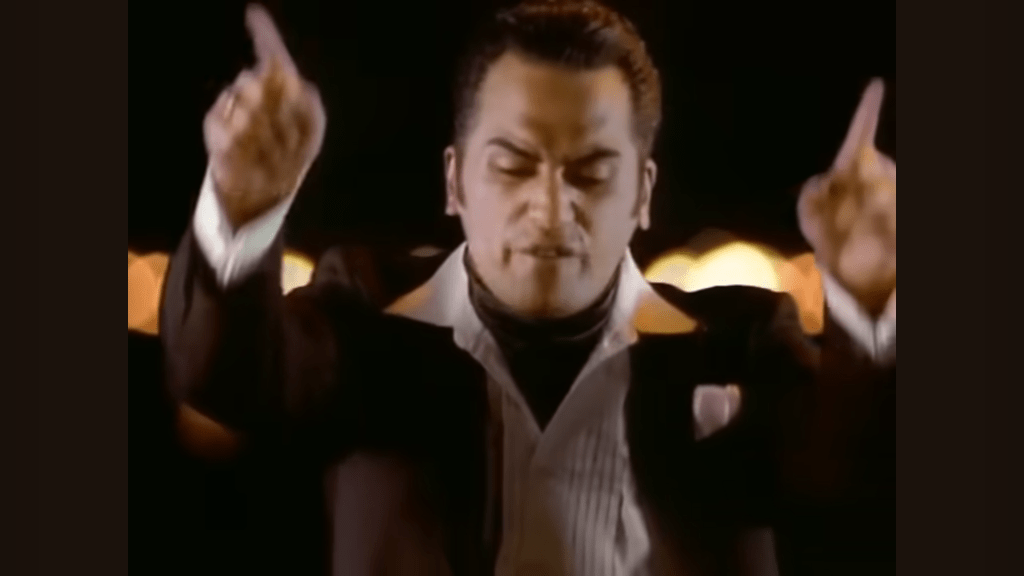

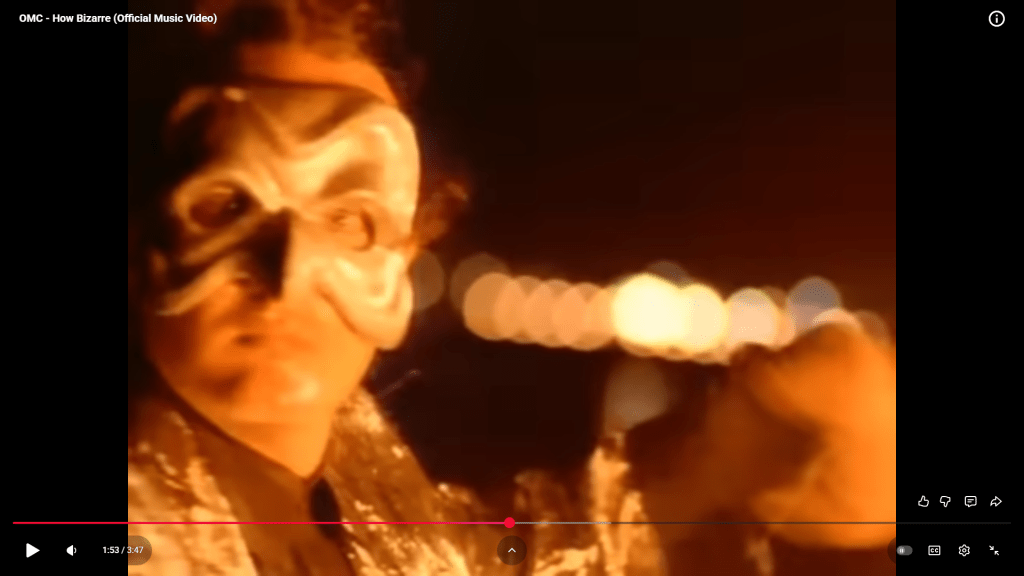
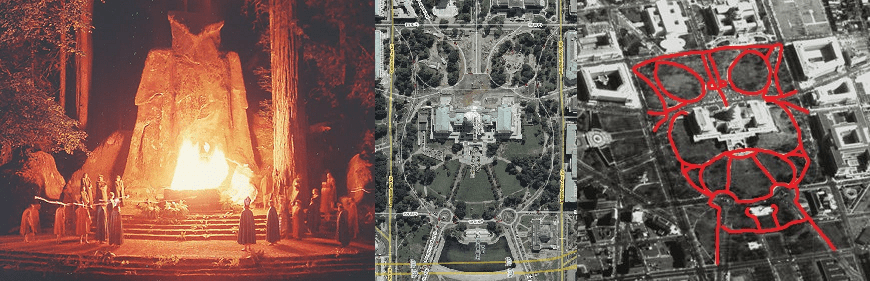
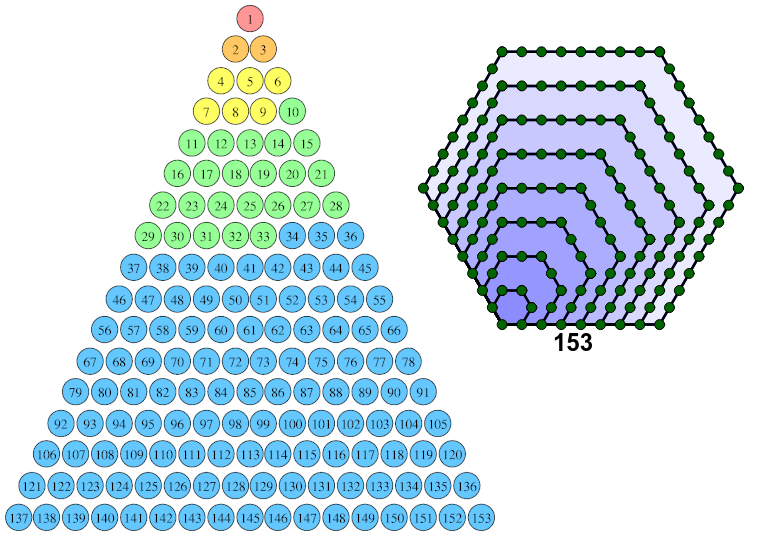
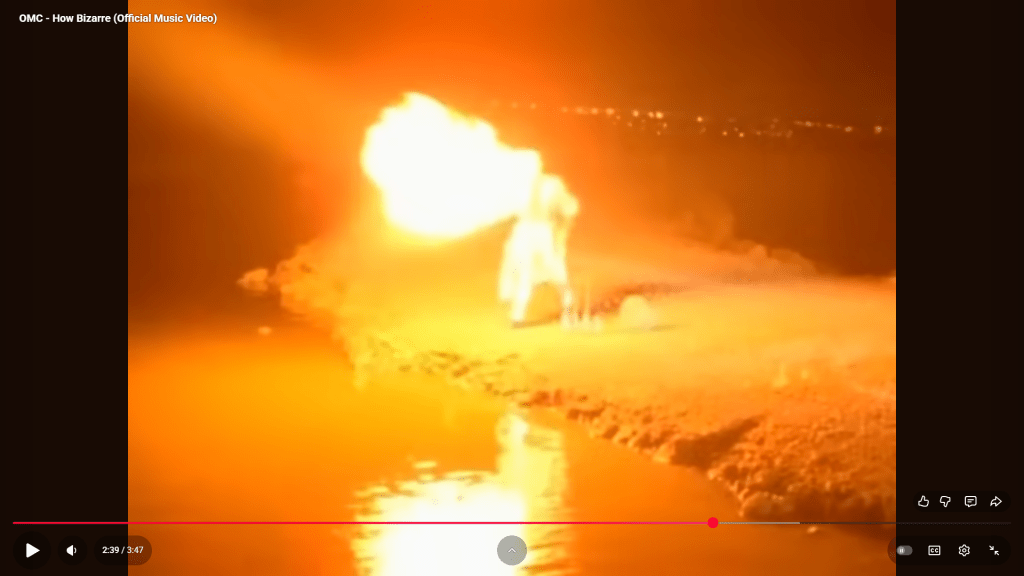

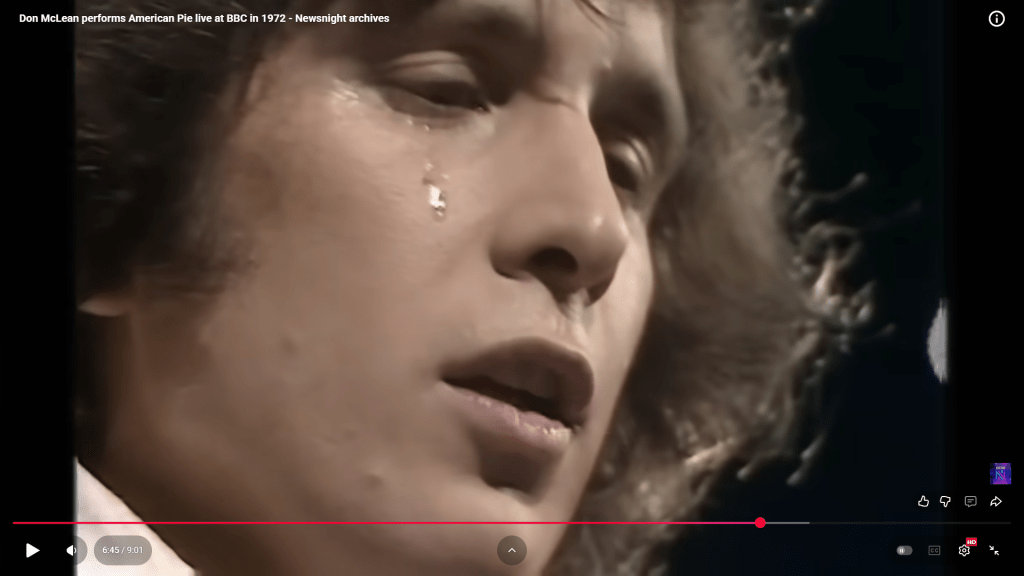
 The Heart of a Lion