Tracing God’s Fingerprint in Genesis 46 and Numbers 7
In The Marriage Supper of the Lamb – Part 2 we saw that Scripture by itself, as “letter,” is dead; it is the Holy Spirit who makes the Word alive—for, “the letter kills, but the Spirit gives life” (2 Corinthians 3:6). Any study of the Bible that focuses only on the text as an academic object usually misses the depth of meaning God intended—especially in the Old Testament.
So can I “prove” my understandings are correct? Not in a mathematical way. The only real confirmation is if the same Holy Spirit bears witness in your heart. There is also a second safeguard: no true understanding of Scripture will contradict any other part of Scripture. If an interpretation requires us to ignore even a single verse, it is not from God. The understandings I present here are, to the best of my knowledge, in harmony with all of Scripture—and I welcome honest testing and challenge on that basis.
Every Word as Seed
Quoting Moses, Jesus said, “Man shall not live by bread alone, but by every word that comes from the mouth of God.” To me, that means every word in Scripture matters.
Why are we told Peter caught exactly 153 fish in John 21:11? Why, in the middle of one of the longest and hardest-to-read genealogies in the Bible, does Nehemiah 9:11 speak of “a stone” being cast “into mighty waters,” while Exodus 14:21 says a strong east wind parted the sea?
These kinds of details began to stand out to me. A new texture—and, most of all, life—began to emerge, as if a new dimension opened above the black letters on a white page. Meaning began to “float” above the text in the illuminating golden light of the Lampstand.
What I call God’s “signature” in Scripture—patterns that authenticate the Bible as His Word in a way no human author could have orchestrated—is exactly this: illuminated meaning that seems to rise from the pages and brings a deep confidence and peace that it truly is God’s Word.
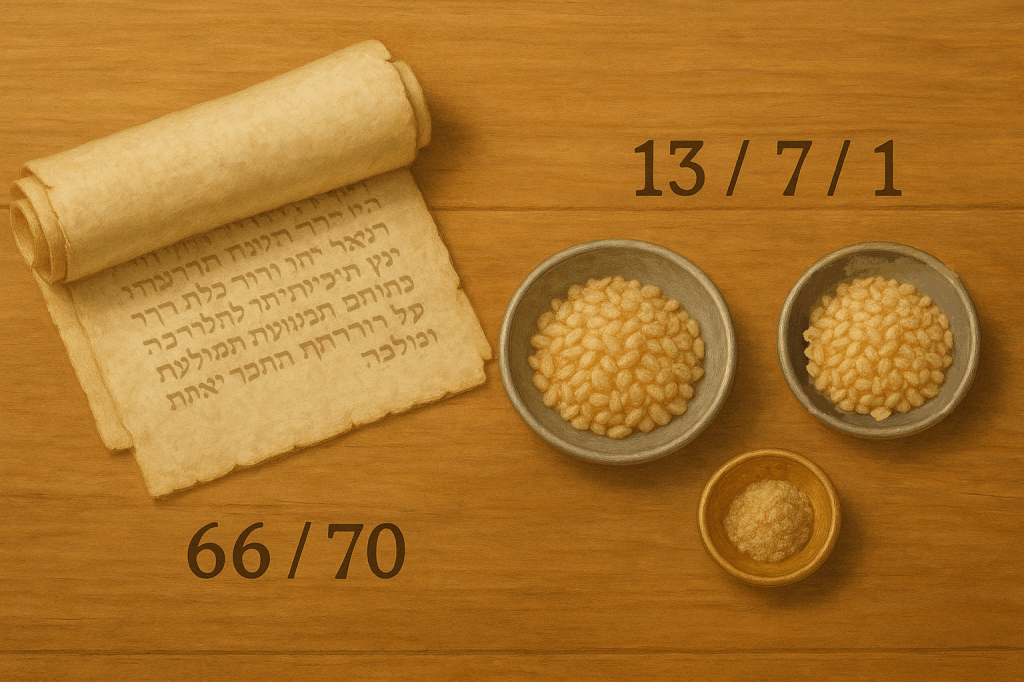
The Seed of the House of Israel—66/70
Genesis 46 records Jacob going down to Egypt with his family. The chapter carefully lists the descendants of Jacob who went to Egypt, and then gives us two counts:
- 66 direct descendants who went down with Jacob
- 70 total when Jacob himself and Joseph’s two sons are included
Scholars debate how to reconcile these numbers. Most readers overlook them. To me, the 66/70 pattern looked deliberate, but I did not yet know what it meant. I simply kept it prayerfully tucked away in my heart.
Some time later, as I was planning another full read-through of Scripture, that unanswered question came back.
I am currently reading through the Bible for the ninth time. I don’t read from Genesis straight through to Revelation. Instead, I mix the order to see more cross-connections. In one of these cycles, I decided to split the book of Psalms into its five internal “books,” because Psalms is so long and is already clearly partitioned.
When I did that, I realized something simple but striking:
- If you count Psalms as one book, the Bible has 66 books.
- If you count Psalms as five books, the Bible has 70 “books”.
There was that 66/70 pattern.
When I saw that, Genesis 46 came back into my mind. I had been praying over the double count there, and now I saw a link:
- In Genesis 46, the seed of the house of Israel is counted as 66/70.
- In the Bible, the books that carry God’s Word also form a 66/70 pattern.
My conclusion is not that “the Bible is 66/70” as a bare number. Rather: 66/70 is the number of the seed of the house of Israel, and Scripture is that seed.
Here it is important to remember who Israel is.
- “Israel” is a name God Himself gives to Jacob after he wrestles with Him: “Your name shall no longer be called Jacob, but Israel, for you have striven with God and with men, and have prevailed.” (Genesis 32:28)
- In the New Testament Paul explains that “Israel” is defined by faith, not mere genetics: “For not all who are descended from Israel belong to Israel… it is not the children of the flesh who are the children of God, but the children of the promise.” (Romans 9:6–8; see also Galatians 3:7, 29)
- Daniel 12 adds an Old Testament witness to this same idea: “At that time your people shall be delivered, everyone whose name shall be found written in the book.” (Daniel 12:1) Here “your people” are identified not merely by bloodline, but as those whose names are written “in the book” (elsewhere called “the book of life” in Revelation 20:12; 21:27).
- Revelation 7 gives a New Testament picture of “Israel” at the end of the age: an angel seals “the servants of our God … sealed from every tribe of the sons of Israel” (Revelation 7:3–4). Verses 5–8 then list the offspring (sons) of the tribes, notably omitting Dan.
The “house of Israel” is therefore not just an ethnic label; it is the house of God’s people—those who belong to Him and walk by faith.
Scripture itself uses “seed” both in the physical (descendants) and spiritual sense (the Word):
- In the parable of the sower, Jesus says plainly: “The seed is the word of God.”
- Paul speaks of Christ as the Seed and of us as Abraham’s offspring by faith (Galatians 3).
So when I see Genesis 46 highlighting the seed of Israel as 66/70, and the canon of Scripture mirroring 66/70 depending on how we count Psalms, I see a quiet signature of God that confirms the Bible is the “seed” of the house of Israel—God’s house.
The Structure of the Word of God—13/7/1
This brings us to Numbers 7, another place where, at first glance, the text is repetitive and easy to overlook—and yet another place where I believe God has left His signature authenticating the Bible.
Numbers 7 describes the dedication of the tabernacle. The twelve tribal chiefs bring their offerings. The offerings are identical, and the chapter repeats the full list verbatim, twelve times, once for each tribe. Many readers skim this section. Many commentators summarize it instead of reading it through.
As I prayed over this chapter, I sensed the Lord impress something on my heart:
“Do not skim this. Read every offering, all twelve times. It is this way for a reason. If you are faithful to read it this way, I will give you understanding.”
So I read each repetition of the offerings of the twelve tribes as if I were reading it for the first time.
The next day I started a long journey, on a train from Sumy, Ukraine to Moscow, with a nine-hour stop in Kharkov. As I lay in my cabin, I played back Numbers 7 in my mind, prayerfully considering the details I had read the day before. There were two offerings of grain and oil on silver platters of 130 and 70 shekels, and one offering of incense on a gold platter of 10 shekels.
What did the 13/7/1 mean? Why was there grain and oil on two of them but incense on the third? What did the silver and gold mean?
The more I contemplated it, the more three simple observations stood out:
- There are three dishes: the first two are made of silver, and the last is made of gold.
- The first two hold grain mixed with oil, and the last one holds incense alone.
- Their weights form a 13 / 7 / 1 pattern (130, 70, 10).
Grain and oil match what we have already seen: the Word (grain) made alive by the Spirit (oil). Incense, in turn, is a picture of prayer received in heaven before God (as we see in Revelation 5:8, where we read of “golden bowls full of incense, which are the prayers of the saints” and in Revelation 8:3-5, where incense is offered with “the prayers of all the saints” and then thrown to the earth).
In The Marriage Supper of the Lamb – Part 2, we described grain—which grows above the earth—as symbolic of manna from heaven, and oil as a picture of the Holy Spirit who gives that Word life. So we can see the grain-and-oil dishes as representing the Word of God made alive by the Holy Spirit. Incense clearly pictures prayer.
Even the metals speak. Silver is pale like the moon; gold shines like the sun. The moon’s light is only a reflection of the sun’s light. Silver, then, can picture what is on earth, reflecting heaven; gold points directly to the source—heaven itself.
Seen this way:
- The two silver dishes with grain and oil point to God’s Word and Spirit working in the realm of man.
- The one golden dish with incense points to the heavenly side: worship and prayer before God’s throne.
This 13/7/1 pattern is not random. It appears elsewhere in Scripture in ways that cluster around sacrifice, fullness, and completion. One striking example is the Feast of Booths in Numbers 29, where:
- 13 bulls are offered on the first day,
- the number of bulls decreases day by day down to 7 over 7 days, and
- on the eighth day, there is a single bull for a solemn assembly.
Again we see a 13 / 7 / 1 shape around offerings and consecration.
In Numbers 7, the 130–70–10 shekel dishes form a 13/7/1 pattern and carry exactly the elements we have been tracing: grain and oil (Word and Spirit) on silver, and incense (prayer and worship) on gold. For me, this became another part of God’s “signature”: hidden inside a chapter most people skim, He quietly sketches the basic structure of His Word.
In the Old Testament, Israel is often functioning as thirteen tribes: Joseph is divided into Ephraim and Manasseh, and Levi is set apart in the center around the tabernacle while the other tribes encamp around them. In that light, the “13” can be seen as pointing to God’s Word and Spirit given to the genealogical tribes of Israel—the Old Testament.
In the New Testament, Jesus walks “among the seven golden lampstands,” and we are shown seven churches (Revelation 1–3). The “7” in the second silver dish fits this: the Word of God, made alive by the Spirit, given to the seven churches—the New Testament.
The “1” then points to a single, distinct book: Revelation itself—a book not simply written from earth looking up, but dictated to John in heaven, where the bowls of incense gather the prayers of the saints.
- 13 – the Old Testament: Word + Spirit in the era of the tribes.
- 7 – the New Testament churches: Word + Spirit in the era of the lampstands.
- 1 – Revelation: a heavenly book of incense, vision, and the consummation.
Even the gaps in the numbers—13 down to 7, and 7 down to 1—are 6 and 6, again hinting at the 66 pattern tied to the whole Bible’s sixty-six books.
There is another 13/7/1 pattern echoing this structure inside the New Testament itself:
- 13 letters traditionally associated with Paul, laying foundations of doctrine and practice for the churches.
- 7 other letters (James; 1–2 Peter; 1–3 John; Jude), strengthening, warning, and encouraging believers.
- 1 final prophetic book, Revelation, filled with incense, worship, and end-time vision around the throne of God.
I don’t claim these patterns as a mathematical proof, but I believe they are God’s quiet signature—ordering His Word with a consistency no human author could have engineered, and leaving hints of that order in places like Numbers 7 that most readers pass over quickly.
Taken together, Genesis 46’s 66/70 pattern for the seed of the house of Israel and Numbers 7’s 13/7/1 pattern for the dishes and offerings look to me like two sides of the same signature: the number and structure of the seed of the house of Israel, the Word of God. These are not proofs in a laboratory sense, but if we both have the Holy Spirit, He can confirm what is true and set aside what is not.
How I Came to Read Scripture This Way
For those who are interested in how the Lord led me into this way of reading, I want to share a bit of my own story.
From Ukraine to Daniel 7
I read the Bible twice in my twenties, then on and off for the next two or three decades. In 2011 I became a digital nomad and have lived in many places since. I spent a lot of time in Ukraine—Sumy, Mykolaiv, Crimea, Luhansk, and also the western parts like Lviv and Kolomyia in the southwest. I understood the regional differences and the tensions keeping the nation divided.
When the Maidan protests began in 2013–2014, I followed the news closely. I watched what Western media and U.S. officials were saying, and compared it to what I experienced while living there. It became clear to me that the West was more interested in narratives that justified force than in truth that could lead to peace. I understood then where the U.S.’s meddling would lead.
I remembered Daniel 7, where the bear is told to “arise and devour much flesh.” I understood what I was watching in real time was part of what Daniel saw: the shifting of empires and the approach of a third world war. Russia is the bear, and Ukraine, one of the three ribs in the bear’s mouth.
When the Veneer Came Off the Church
In my twenties I attended a “charismatic Baptist” church. They taught what is often called the “five-fold ministry” from Ephesians 4:11—apostles, prophets, evangelists, shepherds (pastors), and teachers—as if these were institutional offices to be filled and managed.
The main Bible teacher (who bore the title “apostle”) had real insight—and I still believe much of his teaching came from a sincere place. But looking back, the system around him was driven by membership and money, not by the Holy Spirit. Emotion through music and institutional loyalty were often substituted for real spiritual connection, obedience, and truth.
When events in Ukraine escalated, I reconnected with that church, hoping to talk with one of their “prophets.” A true prophet will not simply echo the viewpoint of his own nation; he cares about truth before nationalism. As I listened, I realized their “prophets” were fully Americanized in their worldview. They did not see what was really happening. That was the moment when the veneer came off for me. I saw the institution for what it was.
More importantly, that was when I decided: I need to go back to Scripture myself.
Laying Aside Commentaries
At first, I opened a few well-known Bible commentaries on my screen beside the text. I would read a chapter of Scripture and then read what the commentators said about it.
Then, one day, quietly but clearly, I sensed the Holy Spirit speaking to my heart:
“Stop reading the commentaries. I will teach you.” After that, I began to see a bigger picture. My heavenly Father, through the Holy Spirit and the Word, wanted to have a conversation with me, but a third person was sitting at the table, constantly interrupting, rephrasing and injecting his comments into our conversation. Should a child not be able to understand his own father? Why should a stranger join in and try to talk for the father?
Jesus had already promised, “the Helper, the Holy Spirit, whom the Father will send in my name, he will teach you all things and bring to your remembrance all that I have said to you” (John 14:26). That does not mean we never learn from others, but it does mean that the same Spirit who inspired Scripture must be the One who makes it alive and clear in each of our hearts.
(In everything I write, I have no desire to replace that Teacher; my hope is that your love for the Word of God deepens, and that you find yourself more drawn to meet with God through it.)
From that point on I stopped going to commentaries for understanding. I now purposely use a physical ESV Bible with no commentary as my primary way of reading Scripture. If I don’t understand something, I pray for understanding. Sometimes it’s immediate; sometimes it takes days or longer; but whenever I have sought earnestly, I have received understanding.
Many “scholarly” approaches to the Bible lean heavily on schemes such as historical-critical analysis, source criticism and redaction criticism, and purely literary analysis, all wrapped in highly technical “biblical hermeneutics” that imply only trained experts can really understand the text.
The Bible, however, was given for the whole people of God—for anyone with an open, believing heart—not just for those with degrees and titles.
Those tools can sometimes provide useful background, but they are not the same as listening to the Author with an open heart. If we treat the Bible only as an object of academic study, we may become clever—and also blind.
And the final message is that God’s people need to return to the Word of God—undivided across denominations and continents—peeling back doctrines introduced over the ages by human interests, doctrines that separate us from real relationship and living knowledge of God the Father and Jesus the Son.
In Part 2: Sixes, Sevens, and the Two Witnesses, we will look at another layer in Numbers 7—the six-and-seven pattern in the animal offerings—and how it connects to God’s end-time work in His Church.
And in Part 3: Seven Lamps, One Bride, One King, we will show the completion of the number pattern, as it finishes in Numbers 8, and how it points to the completion of this age.
Discover more from The Heart of a Lion
Subscribe to get the latest posts sent to your email.

 The Heart of a Lion