A Prophetic Warning of Financial Judgment
I’ll be honest: I have never liked this song. I do not enjoy the sound, and the lyrics are not something I would ever sing along with on purpose. There are many other songs I would rather cover for Illuminati messaging.
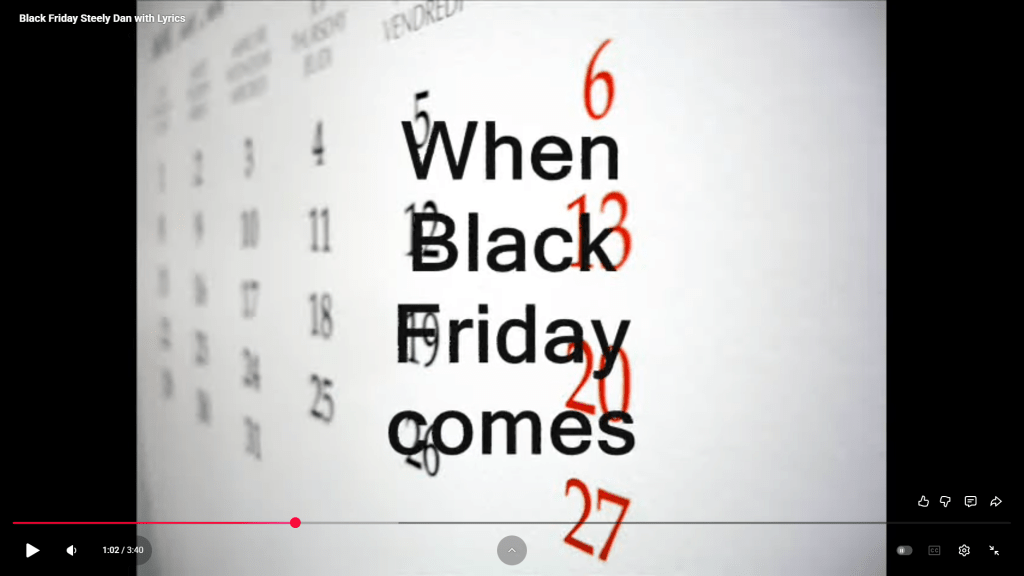
So why Black Friday today? Because the “calendar” that flashes on screen at 1:02 happens to line up with this month (“Vendredi” is the French word for Friday), and as I write, the U.S. again seems poised on the edge of another foreign conflict that could trigger a financial “Black Friday.” I am not setting dates, and I am not claiming a Friday this particular month will be the one. But the timing is uncanny enough that I felt prompted to finally write about it.
As with the other songs in this series, I believe Black Friday is not just a quirky rock track about a market crash. I believe it is a message—told from the viewpoint of Satan—about a future day of judgment on the financial system and on the people who trusted it.
Listening to Black Friday in the First Person
Before we go line-by-line, there’s a basic orientation that, I believe, makes the whole song snap into place: Black Friday is written in the first person of Satan. The “I” who speaks expects a day of mass death, waits at the “door” to catch falling souls, gloats about “collect[ing] everything I’m owed,” and talks about staking his claim and changing his name. That is the voice of the destroyer, not of an ordinary man.
Even the band’s name points in that direction. “Dan” is the tribe that does not appear in the list of Israel’s tribes in Revelation 7, and Numbers 2 places the standard of Dan’s camp on the north side—already hinting at a northern, warlike role. Dan turned to idolatry; in Judges 18, six hundred men with weapons of war from Dan steal a carved image, a metal idol, and a priest who is happy to sell his services for money, then wipe out a quiet city and set up their own false worship there (Judges 18:11–31). The number 600 is repeated three times in that chapter—three sixes, a 6-6-6 drumbeat wrapped around a tribe marked by violence and counterfeit worship. Jacob’s prophecy over Dan was:
“Dan shall judge his people
as one of the tribes of Israel.
Dan shall be a serpent in the way,
a viper by the path,
that bites the horse’s heels
so that his rider falls backward.” (Genesis 49:16–17, ESV)
That picture—a serpent striking the horse so the rider is thrown backward—matches the pattern of Revelation 17, where the beast turns on the woman who rides it: the harlot rides the beast, the beast hates the harlot, and the beast destroys her. Dan is the tribe that bites from underneath and brings the rider down—the hidden power that helps throw the rider off the beast.
“Steely Dan” pushes that image further. The name was taken from a crude mechanical device in William S. Burroughs’ Naked Lunch—a metallic instrument of sexual penetration, violation, and domination. Symbolically, this represents a counterfeit consummation, offering temporary pleasure but not leading to life. Satan is the master of counterfeit; his “unions” corrupt rather than create. Where the true Bride of Christ will one day know a real spiritual consummation—receiving an incorruptible heart and eternal life—his false consummations leave people hollow and, in the end, under eternal death. The “steely” aspect also echoes the iron teeth and claws of the final beast in Daniel 7—cold, hard, engineered metal used to tear, crush, and conquer.
Put together, you get “Steely Dan”: a hardened, predatory Dan-system under Satan’s tutelage. These are the global schemers and elites who present themselves as virtuous—“those who say that they are Jews and are not, but are a synagogue of Satan” (Revelation 2:9; 3:9)—but whose loyalty is to the serpent.
Because Scripture is God-breathed—written by human hands but directed by the Spirit—I believe even the numerical patterns around Dan are not accidental. That repeated “six hundred” in Judges 18 is one of those patterns, echoing the 6-6-6 mark of the beast. When you hold all of that in mind, Black Friday reads like what it is: a smug monologue from the serpent-king and his tribe, celebrating the day they expect to bring judgment on a world they helped corrupt.
Verse 1 – Catching the Grey Men
When Black Friday comes
I’ll stand down by the door
The speaker is not a nervous investor—the “door” is the gate to death and hell. When the crash comes, Satan is already in position.
And catch the grey men when they
Dive from the fourteenth floor
The “grey men” are those anonymous, suited figures who run the system: bankers, traders, executives. When the system collapses and they despair—picture some committing suicide by jumping out of windows—and Satan is there to “catch” them—collect their souls.
The “fourteenth floor” carries a second layer. In many high-rises the 13th floor is skipped for superstition, so the 14th floor is really the 13th, which I believe fits a pointer to the 13th tribe as I described above. Hiding it under a “fourteen” fits how the system hides its true nature.
When Black Friday comes
I’ll collect everything I’m owed
Scripture calls Satan “the accuser of our brothers” (Revelation 12:10). He keeps record of sins and claims those who never brought their debt to the cross. On this Black Friday he is not panicking—he is collecting.
And before my friends find out
I’ll be on the road
Those who serve him now—occultists, Baal worshipers, high-level “friends”—think they are insiders. This line says the opposite. Before they realize what has really been set in motion, he is already gone. They will discover too late that they were never truly his friends; they were just tools.
Chorus – “Don’t Let It Fall on Me”
When Black Friday falls you know it’s got to be
Don’t let it fall on me
Here the voice shifts toward the crowd. On the surface, it sounds like a plea not to be ruined by the crash. Underneath, I hear a taunt: judgement has to fall; the only question is on whom. Those tied to the system—who wear the “cloak of Shinar” and trust Babylon’s money more than God—are exactly the ones who will be crushed when it collapses. (In Joshua 7, the “cloak of Shinar” is a beautiful Babylonian garment that Achan hides under his tent with stolen silver and gold. Shinar is the land of Babylon, so the cloak pictures trusting in Babylon’s wealth and security instead of God’s promise—a trust that ends in judgment.)
Verse 2 – Muswellbrook, Red Words, and Kangaroos
When Black Friday comes
I’ll fly down to Muswellbrook
Muswellbrook is a small town in Australia. Donald Fagen, lead singer, has said they chose it by putting a finger on the map at the place they thought was furthest from New York. In the context of this song, it pictures the speaker fleeing to the ends of the earth while judgment falls on the center he has been using. Black Friday is not just about a bad trading day; it hints at a Black Friday for New York itself.
Revelation 18 first speaks of Babylon’s plagues coming “in a single day” (Revelation 18:8), which I believe applies to the fall of the U.S. as a whole. Then it narrows to “one hour” judgments and a specific commercial city whose smoke is seen from the sea, and finally to a vision of a great stone thrown into the sea as a picture of that city being violently destroyed (Revelation 18:10, 17, 19, 21). In my understanding, that commercial harbor city points to New York: the financial heart of the Babylon system, destined not only for economic collapse but for a sudden, physical destruction from the sea. The voice speaking in Black Friday expects that day to come—and plans to be on the far side of the world when it does.
Gonna strike all the big red words
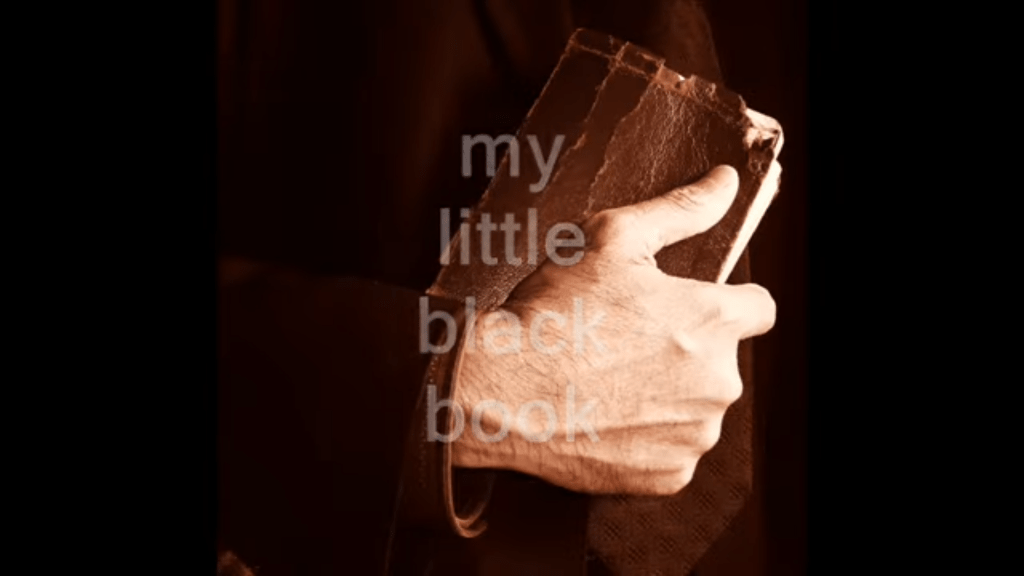
From my little black book
A “red-letter Bible” prints Jesus’ words in red. In this line, the speaker is not rejecting the Bible as a whole—he wants to keep the “little black book”—but he wants to erase the red. Keep the structure, keep the law, keep the language of God, but remove Christ’s voice, authority, and victory.
This is exactly how Satan works with Scripture. Paul writes that “the letter kills, but the Spirit gives life” (2 Corinthians 3:6). Satan loves the letter without the Spirit. He uses God’s good law—which no fallen human can fully keep—to condemn, control, and accuse. Jesus comes to bring mercy, a new heart, and eternal life. If you can take Jesus out of the Bible, you have a perfect control system: a religion of rules and guilt with no true forgiveness, leading only to condemnation and death.
That is why the Bible appears so often in Illuminati symbolism. Satan knows Scripture very well. He quotes it, twists it, and repackages it so that the outer form of “the Word of God” remains, but the living Word—Christ Himself—is pushed out. In that light, “striking out the big red words” is not a throwaway phrase. It is a boast about keeping the black-ink framework of religion while quietly erasing the One who gives it life.
Gonna do just what I please
Gonna wear no socks and shoes
Here the voice revels in lawlessness. No restraint, no covering, nothing between him and the dust. It is rebellion dressed up as freedom.

With nothing to do but feed
All the kangaroos
The kangaroos are a picture of the global elite who do Satan’s bidding. Satan “feeds” them with money, flattery, fame, and subservient power, and they jump when he says “jump”—and in the end he laughs at them as they go to their destruction.
Chorus 2 – On the Hill
When Black Friday comes I’ll be on that hill
You know I will
Here the speaker is looking ahead to Black Friday with confidence. “On that hill” is not just a random image; it echoes Satan’s high vantage point in the temptation of Jesus, where “the devil took him up and showed him all the kingdoms of the world in a moment of time” and then tempted Him to throw Himself down (Luke 4:5, ESV). I do not see that as just a single snapshot, but as a panoramic view across history—seven Babylon systems, all the kingdoms of the earth under his temporary authority—before the moment he is finally cast down.
So when he says he will be “on that hill,” it pictures Satan still in his high place, watching the world’s systems and waiting for the day he believes will be his great harvest. Jesus has already spoken the outcome: “I saw Satan fall like lightning from heaven” (Luke 10:18, ESV). Satan wanted the Son of God to throw Himself down; instead, Jesus refuses the temptation and, through the cross and resurrection, reverses the table—Satan is the one who is thrown down. Black Friday, in that sense, is the day he expects to stand at the pinnacle above the world one last time, just before his fall and final union with the mind of the anti-Christ in the eighth and final kingdom.
Verse 3 – Digging a Hole
When Black Friday comes
I’m gonna dig myself a hole
I see this as a foreshadowing of Revelation 12, when Satan is cast down from heaven. Revelation describes “war arose in heaven… and the great dragon was thrown down… he was thrown down to the earth, and his angels were thrown down with him,” followed by the warning: “Woe to you, O earth and sea, for the devil has come down to you in great wrath, because he knows that his time is short” (Revelation 12:7–9, 12, ESV, excerpts). In the song, Satan talks as if he is choosing to “dig” his own hole and lie down in it, but scripture shows the reality: he is forcibly expelled from heaven, locked to the earthly realm in rage—that is the real Black Friday he is preparing his followers for.
Gonna lay down in it
’Til I satisfy my soul
He lies down in that self-dug hole, determined to wring from the earth everything he can. His “soul” is only satisfied by destruction.
Gonna let the world pass by me
The world spirals into chaos; he is content to sit in his hole and watch nations devour each other.
The Archbishop’s gonna sanctify me
“Archbishop” has a double meaning. On one side, it hints at God’s sovereign permission: God allows the beast his limited season. On the other, it hints at the false prophet—a religious leader who will “sanctify” the beast before the world and tell everyone to worship him (Revelation 13).
And if he don’t come across
I’m gonna let it roll
Even if God doesn’t sanctify him, he will still rebel. Whether God allows it or not, he is determined to “let it roll”—to push sin and destruction as far as he can, even knowing the outcome is his own doom.
Chorus 3 – Staking His Claim, Changing His Name
When Black Friday comes I’m gonna stake my claim
On this day, he asserts ownership. The financial system may be collapsing, but he is staking his claim on the soul’s of the people who trusted it more than God.
I guess I’ll change my name
Before he rebelled against God his name was “Lucifer” His followers still like to use the name “Lucifer”—angel of light. Scripture, though, calls him Satan, the adversary. In the end he will be known by what he truly is. When this Black Friday plays out, the mask of “light” is gone. His “name change” is complete.
The Calendar at 1:02 – The Number of the Destroyer
Now back to the image at 1:02 in the video.
At 1:02 a calendar flashes on screen. The days of the week are in French; vendredi is Friday. In certain years and months that pattern of dates matches a real calendar—and this month happens to be one of them.
One detail that is difficult to ignore is that Saturday’s are written in red. Saturday’s are the last day of the week, and are the Sabbath, also called the Lord’s day. Saturday comes after Friday. The end times are called a dark night in Scripture (verse), and Jesus calls Himself the Bright Morning Star (Rev 22:??), who comes at the end of the dark night. So is Black Friday, a moment in time – such as a major stock market crash, a short period of time, the end times in which the U.S. is destroyed by nuclear fire and the world goes into WW3, or a whole era, from Jesus’s first coming to His 2nd coming. Some people believe the earth has eras of rough 1000 years, 4000 years before Christ, 2000 years until his 2nd coming, and then 1000 years of His reign on earth – 7,000 years – 1000 years is as a day unto the Lord (verse).
One detail is hard to ignore: Saturdays are printed in red. Saturday is the weekly Sabbath—the ordinary “Lord’s day” of rest after six days of work. Many Christians also see a prophetic pattern here: “with the Lord one day is as a thousand years” (2 Peter 3:8), so six thousand years of human history are like six days, and the seventh “day” is the thousand-year reign of Christ. In that frame, Friday is the last working day before the Sabbath rest. Black Friday can therefore be read on three scales at once: (1) a literal crash day, (2) the short end-time window when the U.S. system burns and World War III erupts, and (3) the final “Friday-era” — the sixth thousand-year span leading right up to Jesus’ return, before the red “Saturday” of His millennial reign. The red Saturdays on the calendar hint at that coming Sabbath-age Satan hates and wants to erase, just as he wants to erase the red words of Jesus from Scripture.
I believe it is all three. The red Saturday is something Satan doesn’t want. The end of the era, ending in the Lord’s Day. This aligns with Satan wanting to erase the red words from the Bible.
The timestamp itself is a message: 1:02 → 102.
In Hebrew gematria, Abaddon—“the angel of the bottomless pit” in Revelation 9—adds to 102 (https://www.gematrix.org/?word=abaddon). Scripture says of him:
They have as king over them the angel of the bottomless pit. His name in Hebrew is Abaddon, and in Greek he is called Apollyon.” (Revelation 9:11)
Apollyon means destroyer. So 102 is tightly linked to the Destroyer.:

In New York City, the Oculus building beside One World Trade opens its roof for 102 minutes once a year, marking the time between the first impact and the collapse of the second tower on 9/11. The very name Oculus means “eye”—an architectural echo of the eye of providence on the U.S. one-dollar bill.

That eye sits in a floating capstone above the larger pyramid base—a split structure that pictures his rule from the unseen realm over earthly institutions—with the Latin motto Annuit Coeptis (“He has favored [or winks at] our undertakings”) and Novus Ordo Seclorum (“new order of the ages”)—the same spirit as an “eye” that winks open for exactly 102 minutes over the rebuilt World Trade site.
So Abaddon, the destroyer, connects to 9/11 in three ways at once:
- 102 as his Hebrew gematria,
- Apollyon meaning destroyer, and
- the 9:11 chapter-and-verse reference to the angel of the pit.
In Black Friday we therefore have:
- a song about a catastrophic crash,
- sung in the first person of Satan,
- marked at 1:02 by a calendar that matches specific real months,
- branded with a number many associate with Abaddon and with 9/11.
I do not see that as random.
Does this calendar point to a real month when the U.S. financial system finally breaks? Will it fall on a literal Friday? I don’t know—but it easily could. The dollar is under pressure, and a controlled demolition of the current system would give the global elite a clean slate to roll out their “new order” under the beast.
Scripture warns that end-time Babylon’s judgment comes suddenly: “her plagues will come in a single day… she will be burned up with fire” (Revelation 18:8), and three times merchants lament that “in a single hour” her wealth is laid waste (Revelation 18:10, 17, 19). Jeremiah speaks of God bringing “a destroyer at noonday” so that terror falls “suddenly” (Jeremiah 15:8). That is exactly the flavor of Black Friday: a last dark Friday-era, a destroyer coded as 102, and a collapse that comes faster than anyone expects.
How This Fits the Larger Pattern
In other articles on this site, the pattern is similar: coded numbers, images of burning Americans, and a mocking tone toward people who never notice what is being shown to them.
Here, Black Friday fits into that same pattern, but focused on the financial side:
- The destroyer stands ready at the “door” while grey men dive from towers.
- The Bible is kept, but the red words of Jesus are struck out.
- Servants are just “kangaroos” to be fed until they fall.
- A pit is dug; a counterfeit “sanctification” is given; a claim is staked.
- The calendar at 1:02 quietly stamps the whole thing with the number of the destroyer.
In your own life, this raises a simple question: Where is your trust?
If our security is in the markets, in digital accounts, in Babylon’s paper promises, then a real Black Friday—whenever it comes—will be terror. That is the “cloak of Shinar”: covering ourselves with a garment of financial confidence instead of trusting the God who judges the system.
If our security is in Jesus, then even a Black Friday becomes something different. It is still painful; it may cost us dearly in earthly terms. But it is no longer the day the destroyer “collects what he is owed.” Our debt has already been paid.
I am not timing the market, and I am not setting dates. What I am saying is that songs like Black Friday are not accidental. They are part of a long-running pattern of messaging in music—taunting hints from powers that think they are untouchable and warnings for anyone with ears to hear.
The wise response is not to decode every date, but to move our trust off Babylon’s books and onto the One who cannot be shaken, before the real Black Friday comes.
Discover more from The Heart of a Lion
Subscribe to get the latest posts sent to your email.

 The Heart of a Lion