Drinking the Cup: Receiving the Holy Spirit
In Part 1, we looked at the marriage supper as a present reality: Jesus Christ feeding us with His own flesh, the pure Word of God, and calling us to gather that heavenly manna every day. In John 6 He says, “Truly, truly, I say to you, unless you eat the flesh of the Son of Man and drink his blood, you have no life in you.” In Part 1 we focused mainly on His flesh; in this Part we will focus mainly on His blood.
If eating His flesh is taking in the Word, then drinking His blood is receiving the Holy Spirit so that the Word becomes alive inside us. Without the Spirit, even the most accurate Bible reading remains dry and lifeless. With the Holy Spirit, the same words become living bread and living wine.
This is not a side topic. Learning to receive and walk with the Holy Spirit is central to loving God with all our heart, soul, mind and strength. At the marriage supper of the Lamb, we do not read as scholars trying to craft a sermon, but as a Bride sitting with her Bridegroom—opening the Bible and our heart together, prayerfully listening, responding, and seeking to understand His heart behind the words. Listening to our Father—really listening, in this two-way conversation of Word and prayer—is an act of love and respect.
In this article we will look at how Scripture itself ties together three things:
- The Word of God (the flesh of Jesus)
- The Holy Spirit (the blood / wine / oil)
- Our heart (the vessel, the tent, the wineskin)
“The Letter Kills, but the Spirit Gives Life”
The Bible is very clear that there is a way to handle Scripture that brings death, and a way that brings life.
For the letter kills, but the Spirit gives life.
– 2 Corinthians 3:6
For the life of every creature is its blood.
– Leviticus 17:14
The Word of God, taken only as “letter,” can kill—not because there is anything wrong with the Word, but because our heart and our approach are wrong. The same Word, taken with a washed heart and a right spirit, becomes life when joined with the Spirit of God. Scripture links “life” with the blood; the life is in the blood. Spirit and life go together.
Create in me a clean heart, O God,
and renew a right spirit within me.
– Psalm 51:10
David is not claiming that he already has a clean heart. He is crying out for something only God can create. In this age, our part is to come before God with a washed heart—being honest about our struggles and sins, asking (or at least allowing) Him to change us, and then letting Him fill it with His Word and His Spirit—while we wait for the day He gives us a truly new, perfectly clean heart at the consummation—the marriage that comes after the supper.
So when Jesus speaks about drinking His blood, He is not inviting us into some mystical ritual for its own sake. He is calling us to receive the Holy Spirit, who makes the written Word alive in us. The Word of God does not come alive in us if we try to understand it based only on our own intellect. We must have the Holy Spirit. This is what Jesus meant by drinking His blood.
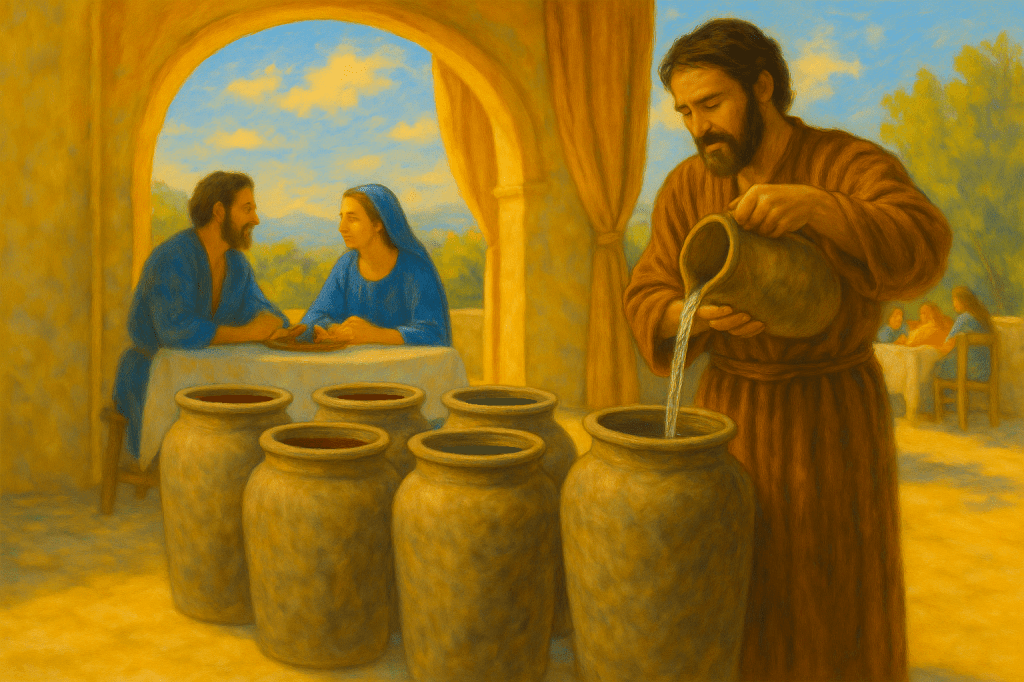
The Wedding at Cana – Empty Jars to Living Wine
John tells us that Jesus began His public signs at a wedding:
On the third day there was a wedding at Cana in Galilee, and the mother of Jesus was there. 2 Jesus also was invited to the wedding with his disciples. 3 When the wine ran out, the mother of Jesus said to him, “They have no wine.” 4 And Jesus said to her, “Woman, what does this have to do with me? My hour has not yet come.” 5 His mother said to the servants, “Do whatever he tells you.”
6 Now there were six stone water jars there for the Jewish rites of purification, each holding twenty or thirty gallons. 7 Jesus said to the servants, “Fill the jars with water.” And they filled them up to the brim. 8 And he said to them, “Now draw some out and take it to the master of the feast.” So they took it. 9 When the master of the feast tasted the water now become wine, and did not know where it came from (though the servants who had drawn the water knew), the master of the feast called the bridegroom 10 and said to him, “Everyone serves the good wine first, and when people have drunk freely, then the poor wine. But you have kept the good wine until now.” 11 This, the first of his signs, Jesus did at Cana in Galilee, and manifested his glory. And his disciples believed in him.
– John 2:1–11
There is a simple, prophetic picture here:
- The six stone jars represent the human heart. Six is the number of man. Hollow, stone vessels, designed to be filled.
- Jesus tells the servants to fill the vessels with water. This is our part. The servants had to act and the water represents washing. Now the vessels with water—human, washed hearts—are ready for His change.
- Then Jesus turns the water into wine. That is His work alone. This pictures the heart filled with the Holy Spirit.
Luke 5:36–38 uses similar imagery when Jesus compares our hearts to wineskins that must hold new wine. The pattern is consistent: we bring a soft, yielded, washed heart; He fills and begins to transform us by His Spirit.
The marriage supper of the Lamb is this very work: His Word, made alive by the Holy Spirit inside hearts that we wash and open to Him. In this way, the marriage supper is the true food that prepares us for the actual marriage consummation, when we will receive a truly new and perfect heart — His perfect nature — which is the necessary foundation for living forever in the paradise of God.
The Tent of Meeting – Stepping into God’s Heart
In Exodus, God gives detailed instructions for the tent of meeting. These details are not just ancient ritual; they reveal how God invites us into fellowship with Himself.
The tent has two chambers: an outer sanctuary, which is holy, and an inner sanctuary, which is the Holy of Holies. Its walls are scarlet, blue, and purple like the walls of a heart, and its covering is of tanned (dyed red) goat skins (Exodus 26), which are soft. Its design represents a heart, the heart of God.
To enter, one must be washed and then sprinkled with the blood of the sacrifice (Exodus 29). Inside the outer sanctuary is:
- The table of the Presence (manna from heaven, bread of the Presence)
- The lampstand with seven lamps (light of the Spirit)
Paul helps us see what this means for us:
For a tent was prepared, the first section, in which were the lampstand and the table and the bread of the Presence. It is called the Holy Place. 3 Behind the second curtain was a second section called the Most Holy Place…
8 By this the Holy Spirit indicates that the way into the [Most Holy Place] is not yet opened as long as the first section is still standing 9 (which is symbolic for the present age).
– Hebrews 9
The outer sanctuary, with table and lampstand, is symbolic for the present age. It is where God meets His people now.
- The bread of the Presence pictures Jesus, the manna from heaven, the Word of God.
- The lampstand with seven lamps pictures the Holy Spirit (compare Revelation 1:12–16).
Thus, after washing, putting on clean clothes, and being sprinkled by the blood of Jesus—remembering what He did for us and that we are His bondservants—we are also to enter into this Holy Place to meet with God. There He meets with us and reveals His heart through the Word of God, illuminated by the Holy Spirit.
In so doing, the Word of God (the flesh of Jesus) is illuminated and comes alive in us by the golden light of the Lampstand (the Holy Spirit, the “blood” of Jesus). Here, in this very real daily “tent of meeting,” formed as a picture of God’s heart, is where the marriage supper happens in very practical terms.
Grain and Oil – Faithfulness, Oil, and the Ten Virgins
All through the Old Testament, God pairs grain (bread) with oil. In a stalk of wheat or barley, the head of grain forms at the very top, holding its seed high above the earth—a simple picture of bread that “comes down” from above, like the manna from heaven, while the oil poured over it points to the Holy Spirit who makes that Word alive.
Grain offerings are always accompanied by oil (for example, in Leviticus 2; 6, Numbers 7 and Malachi 1–2). Word and Spirit are not meant to be separated.
There is a sobering counter-picture in the test of the unfaithful woman by the jealous Husband (Numbers 5:11–31). In that test, the grain offering has no oil. Both the unfaithful and the faithful woman experience pain in the testing; the unfaithful woman withers, but the faithful woman bears her husband many children. This is a cast and shadow of how Jesus, the jealous Husband, tests His Bride. If we are unfaithful and do not have the Holy Spirit in us, the Word of God brings death. But if we do have the Holy Spirit, that same Word brings new life—spiritual offspring—consistent with the commission of the Bride of Christ, the Church (Matthew 28:18–20), to bring Him children by sowing the Word made alive through understanding given by the Holy Spirit.
The same pattern appears in the parable of the ten virgins (Matthew 25:1–13). All ten have lamps. All ten are waiting. The difference is oil. The virgins who were not ready thought the Bridegroom would come for them early in the night, but He came for them late in the night, and they ran out of oil. They did not have the Holy Spirit. Jesus says of them: “Truly, I say to you, I do not know you.”
Most English translations of this parable indicate those that were ready went with Him to the “marriage supper.” However, the original text in Matthew 25:10 uses only γάμος (“wedding” / “marriage”), not δεῖπνον (“supper”), highlighting the difference between the marriage and the marriage feast.
By contrast, Revelation 19:7–9 speaks of both:
“the marriage of the Lamb has come” (ὁ γάμος τοῦ ἀρνίου) and those who are invited “to the marriage supper of the Lamb” (εἰς τὸ δεῖπνον τοῦ γάμου τοῦ ἀρνίου).
This makes a real distinction between the marriage supper and the marriage itself. The supper is preparation time in this age; the marriage is union in the next age.
Personal note: After I had come to believe that the marriage supper is here and now on earth, I read Matthew 25 (ESV) one night before going to sleep and felt deeply disturbed, because it did not fit what I had thought I understood. I tossed and turned for hours until I finally got up, opened an interlinear, and saw that the text said simply “wedding,” not “wedding supper.” It was a relief because it confirmed the pattern I felt the Holy Spirit had impressed upon me—but it continues to bother me because this single added word in translation can bend our understanding and sow confusion on such an important topic.
Jesus later calls Himself “the bright morning star” (Revelation 22:16). Morning comes after night. Isaiah 21:12 says that “morning comes, but also the night.” The foolish virgins expected an early rescue—before the night really gets started. The wise were prepared and endured through the night with oil in their lamps.
So what does faithfulness look like now? It is not enough to say, “I believe.” Faithfulness means:
- We keep coming to the marriage supper—the daily Word.
- We keep coming with a washed heart so God can fill us with the oil—the Holy Spirit—to make that Word alive in us.
- We allow the Spirit to comfort, correct, change, and lead us into right relation and obedience to His purpose.
The Betrothed—the virgin who bears offspring before the consummation (Isaiah 66:7–9)—has made herself ready with righteous deeds here on earth. As Revelation says, “Blessed are those who wash their robes, so that they may have the right to the tree of life” (22:14), and “for the fine linen is the righteous deeds of the saints” (19:8). Those deeds flow from a Word-filled, Spirit-filled heart that brings forth spiritual children for the Bridegroom.
Faith Like a Mustard Seed – Letting the Spirit Teach
Jesus gives a strange picture in Luke 17:6:
And the Lord said, “If you had faith like a grain of mustard seed, you could say to this mulberry tree, ‘Be uprooted and planted in the sea,’ and it would obey you.”
When you read about the faith of the mustard seed, how do you react? Do you think, “I just don’t understand”, and move on? Do you assume that “faith of a mustard seed” is something nobody really has? Or do you stop, ponder, and ask your Heavenly Father for understanding? Are you really “eating” the Word of God and do you believe that the Holy Spirit can teach you?
This is where the Holy Spirit makes the difference between “letter that kills” and “Spirit that gives life.”
For most of our lives, we can read verses like this for years and quietly tolerate a gap between what Jesus says and what we experience. We may treat His words as exaggerations or riddles we are not meant to understand. But His words are true. The gap is not in Him; it is in us.
The point here is not to become obsessed with throwing trees into seas. The point is: will we bring the hard verses to God and ask Him to teach us? Will we hold His words in our heart and wait on the Spirit until He gives understanding?
That is part of drinking the cup. That is what it means to treat the words of Jesus as living, not as religious phrases we skim over.
I encourage you to seek the Lord yourself on this verse in prayer and in the Scriptures; and if you stay with me, in a later article on the Gog and Magog prophecies in Ezekiel and Revelation I will share my understanding of this “mulberry tree” being uprooted and thrown into the sea that I believe He has given me. Food for thought: What kind of fruit is the fruit of a mulberry tree? What “sea” is Jesus referring to? Why would God want a mulberry tree thrown into the sea? I once bought a bottle of mulberry wine and spent several days praying and asking God questions like these before the meaning became clear to me.
The Heart Response – How to Actually “Drink His Blood”
In practical terms, what does it mean to “drink His blood” in the context of the marriage supper?
It is not a mystical feeling we chase, and it is not a special experience reserved for a few. It is “a daily posture of heart” so He can change it over time. It starts with faith and with love for God, which produces a true desire to be pleasing to Him.
Washing Our Heart
We come to God honestly, acknowledging our sins and struggles instead of hiding them, and asking Him—or at least allowing Him—to change us. Sometimes it’s hard to ask for something we don’t yet want, but simply allowing Him to work is already a step in the right direction. We are not promising that we will never fail again; we are bringing Him the heart we actually have. That desire for a clean heart is already the beginning of His work in us.
Prayerfully Reading God’s Word
Just like every child wants to spend time with his father and listen to what he has to say, we read God’s Word expectantly. I picture myself sitting at the table of the Presence, with the golden light falling on the words of the text and God just behind the veil of the temple, wanting to speak to me through it. My heavenly Father is there all the time, waiting.
If a president or world leader made an appointment to meet you, you would go, and you would be on time. You would not expect him to wait endlessly. Yet we often take for granted that our heavenly Father—far greater than any earthly ruler—is always near, waiting to meet with us, and we treat almost everything else as more urgent than sitting and listening to Him. Drinking His blood begins with honoring His invitation to meet with Him in His Word.
Pondering, Not Rushing
I think the first few times we read the Bible, it is fine to move quickly. It is important to see the whole landscape so we can understand each part in context. I am reading the Bible for the ninth time now. I do not worry whether I read one chapter or five. I read until my heart is full of thoughts and questions, and then I stop.
There is a word, ruminate, taken from how a cow chews and re-chews its food over time so it can be fully digested. Digesting God’s Word is no different. If our mind and heart are scattered, we may need to stop, pray for a quiet heart, and read less—but read deeply. The goal is not to race; it is to let the Word sink in until it becomes part of us.
Often we do not get the understanding we are looking for right away. Some things take years. For example, I pondered the wheels of Ezekiel in my heart for a very long time before I came to an understanding. But God cares about the process—the interaction, the questions, the fact that we want to hear Him and understand His heart.
So when we meet a hard saying, we do not shrug and move on. We hold it in our heart. We ask questions. We wrestle. We wait. We believe the Holy Spirit can actually answer and slowly realign our thinking with His. That honest effort is all we can give—and it matters to Him.
Walking Out What We Hear
As understanding grows, our faith grows. As the Holy Spirit becomes stronger in us, our conviction deepens, and we begin to take the next steps He shows us. Sometimes we stumble. Sometimes we suddenly see how far off we have been and feel as if we are moving backward. But we keep coming back to the table.
Over time, as our love for and understanding of the Word and the Spirit grow together, they begin to produce real change and real fruit—“righteous deeds,” the fine linen of the Bride. It is a gradual work, but it is real.
This is the essence of the marriage supper of the Lamb in this age. The table is set now. The food is the pure Word of God. The cup is the Holy Spirit. And our hearts are the vessels we keep bringing to Him—vessels He keeps filling and slowly transforming.
Conclusion – Staying at the Table Until Morning
We are not called to treat the marriage supper as a one-time event, or as something distant in heaven. We are at the table now. Jesus stands at the door and knocks. If we hear His voice and open the door, He will come in and eat with us, and we with Him. (Revelation 3:20)
To love God with all our heart, soul, mind, and strength starts with listening to Him—feeding on His Word and receiving His Spirit day after day. It is to stay at the table when the night grows long, with oil in our lamps, trusting that the Morning Star will rise.
Come to the marriage supper of the Lamb. Eat the unleavened manna from heaven by reading the Word of God with a washed, honest heart. Ask for understanding from the Holy Spirit to make it alive in you. Let Him turn the “water” of washing into the “wine” of His life within you.
The veil into the Holy of Holies is for the next age, when the marriage itself is revealed. For now, we are in the outer sanctuary, in this present age, being washed with the water of the Word and filled with the Spirit (Ephesians 5:26; 5:18). If we will remain at the table—Word and Spirit together—He will make us ready: ready to endure the coming night, to bear Him offspring in this age, and to stand—washed and faithful—when the consummation itself comes.
Discover more from The Heart of a Lion
Subscribe to get the latest posts sent to your email.

 The Heart of a Lion